

Case Studies / Typeform
Typeform
A conceptual product experience study focused on onboarding, activation, integrations and measurement, designed to help users move faster from “I want to try it” to “I have a published, connected form that is useful for my business.”
This case study is an unaffiliated conceptual exercise developed by Pibeca Solutions. There is no commercial relationship, collaboration or official assignment from Typeform or its teams. All brands, names, images and references mentioned belong to their respective owners. Its purpose is to explore opportunities in product strategy, UX, onboarding, activation and data integration based on a publicly recognised SaaS platform.
Strategic and conceptual direction: Beatriz Ávila.
This was not about redesigning Typeform. It was about analysing the moment when a user decides whether the product is truly helping them. That is where value begins.
That was the strategic decision behind the whole exercise.
Why this project exists
Typeform is one of those brands that already owns a very recognisable space: making forms feel less cold, more human, more visual and more conversational.
That is why this case does not start from an aesthetic reading. It is not about creating “a prettier homepage” or redesigning a brand with an already strong identity. The starting point is different: analysing a specific opportunity within the product experience.
In many SaaS products, the critical moment is not the landing page or the sign-up. It is what happens immediately afterwards: when the user enters the product for the first time and has to turn an intention into a concrete action.
They may want to capture leads, collect feedback, validate an idea, receive requests, launch a survey or qualify contacts.
But they still have to decide what structure they need, which questions to ask, what logic to apply, which tool to connect and how to know whether the form is working.
That is where this exercise places the opportunity: reducing the distance between sign-up, creation, publishing, integration and first value.
The challenge
The challenge is not to simplify Typeform or reduce its power.
Typeform is valuable precisely because it allows users to create very different experiences for very different needs. The tension appears when that flexibility requires users to make too many decisions before they reach a useful outcome.
Users do not always arrive thinking, “I want to create a form.” Very often, they arrive with a business goal: capturing qualified contacts, understanding customers better, receiving requests, managing registrations, validating a hypothesis or collecting information to make a decision.
The conceptual challenge was to imagine a first experience capable of helping users translate that goal into a concrete structure: what to ask, in what order, with what logic, with which integration, with what next action and with which success indicators.
This was not only about helping users create a form.
It was about helping them reach first value sooner.
Strategic interpretation
Typeform should not be understood only as a tool for creating forms, but as a platform that helps turn questions into actionable data.
That reading changes the focus of the case.
The main question would not be: “what do you want to create?” but: “what do you want to achieve?”
The difference may seem small, but it changes the whole logic of the onboarding experience.
When the product starts from format, the user has to translate their need into a template, a structure and a flow.
When the product starts from the goal, it can propose a path: what type of form makes the most sense, which questions should be included, which integration could complete the process and which metrics will help determine whether it worked.
In a SaaS product, that difference can directly affect activation, conversion, retention and perceived value.
The strategic decision
The strategic decision was not to approach the case as a redesign of Typeform, but as a conceptual activation study.
The focus is not on explaining the product better from the outside, but on improving the first experience from inside the product.
The proposal is organised around one idea: from goal to first published, connected and measurable form.
That means designing an onboarding experience that does not begin with a blank page or a generic template library, but with a question closer to the user’s business: what do you need to achieve?
Based on that answer, the system can suggest an initial path, a question structure, basic logic, possible integrations and measurement signals.
The intention is not to remove freedom.
The intention is to delay complexity until the user has already achieved something useful.
First, a publishable version. Then, advanced customisation.
Conceptual methodology
This case is framed as a product analysis exercise, not as a full visual redesign.
The methodology starts from one specific question: what happens between a user signing up and experiencing real value inside the product for the first time?
From there, the analysis is organised across five layers:
Intent
What goal the user brings into the product.
Activation
What needs to happen for the user to move forward without getting blocked by a blank page.
Structure
What path, questions and initial logic can help the user build a useful first version.
Connection
What integrations or next actions turn the form into part of a real workflow.
Measurement
What signals show whether that first experience has generated value, and how it can be improved.
The purpose is not to replace Typeform’s internal product, research or data work, but to show how an onboarding hypothesis could be framed, structured and visualised from a strategic perspective.
How success would be measured
An onboarding proposal should not be evaluated only by whether it feels clearer or more attractive. In a SaaS product, the important question is whether it helps users reach value sooner and improves the quality of what happens afterwards.
That is why the validation of this concept should be based on activation, usage and impact metrics.
Time to first value
The time between sign-up and the first useful form being published.
Activation rate
The percentage of users who complete the onboarding flow and reach a publishable first version.
First form published rate
The percentage of users who publish their first form during the first session or within the first few days.
Integration adoption
The percentage of users who connect an external tool, such as a CRM, email marketing platform, spreadsheet, Slack or automation tool.
Completion quality
The quality of the structure created: number of questions, minimum logic, essential fields, clarity of goal and readiness to receive responses.
Drop-off during onboarding
The points in the flow where users abandon the process or get stuck.
First response rate
The percentage of forms that receive responses within an initial period.
Lead quality / response quality
The quality of the data collected according to the selected goal.
Next action rate
The percentage of users who take an improvement action after publishing: editing a question, connecting an integration, reviewing results, creating a follow-up or segmenting responses.
The key would not be to measure only whether the user “finishes onboarding”, but whether onboarding helps them build something capable of generating real value.
From hypothesis to product
To make the proposal visible, the case develops a conceptual screen sequence based on a lead capture journey.
This is not about redesigning the entire product. It is about showing how a first experience oriented around goals could work.
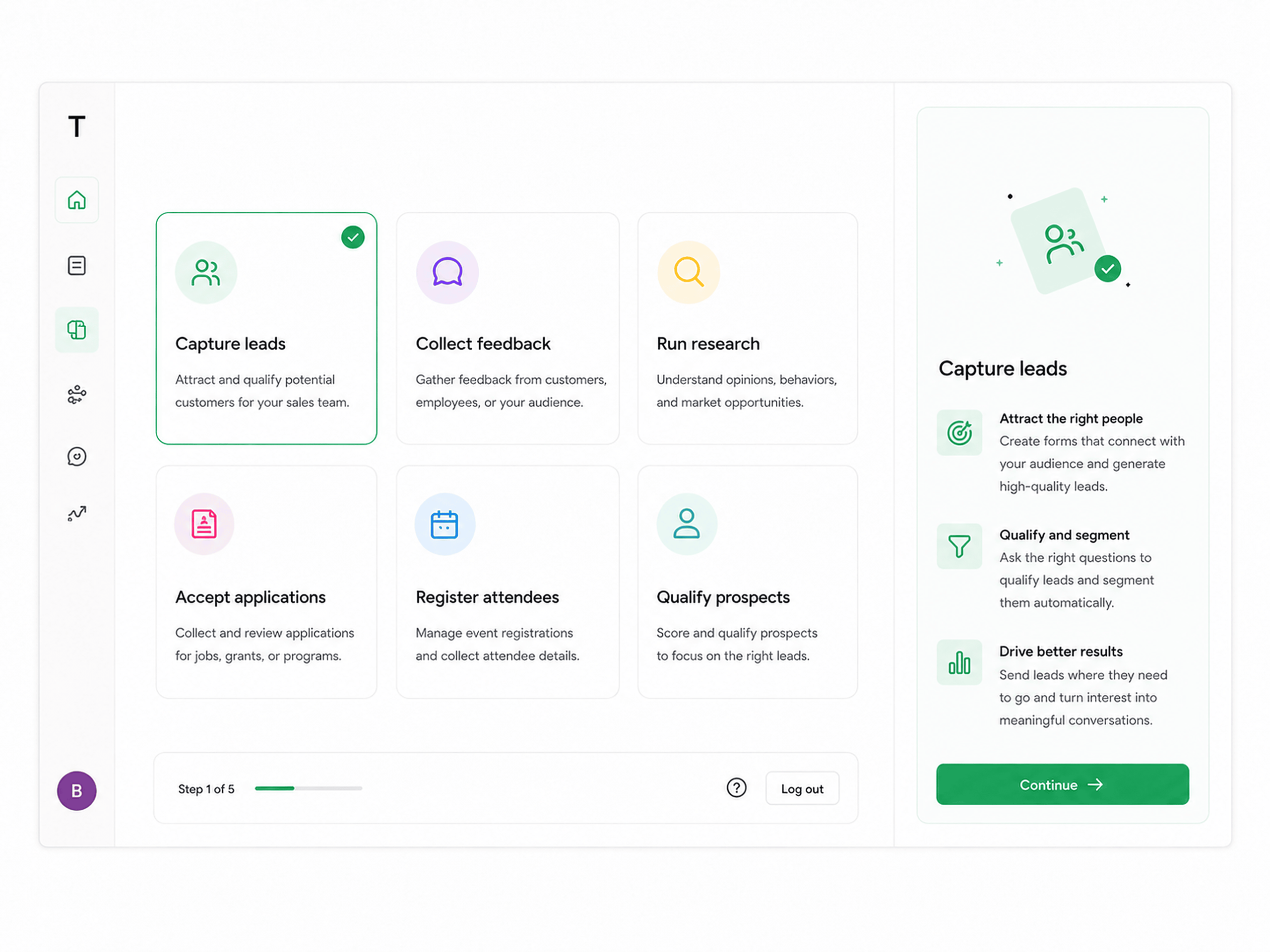
Screen 01 · Goal selection
The user does not start by choosing a template, but by defining what they want to achieve. In this case, they select Capture leads.
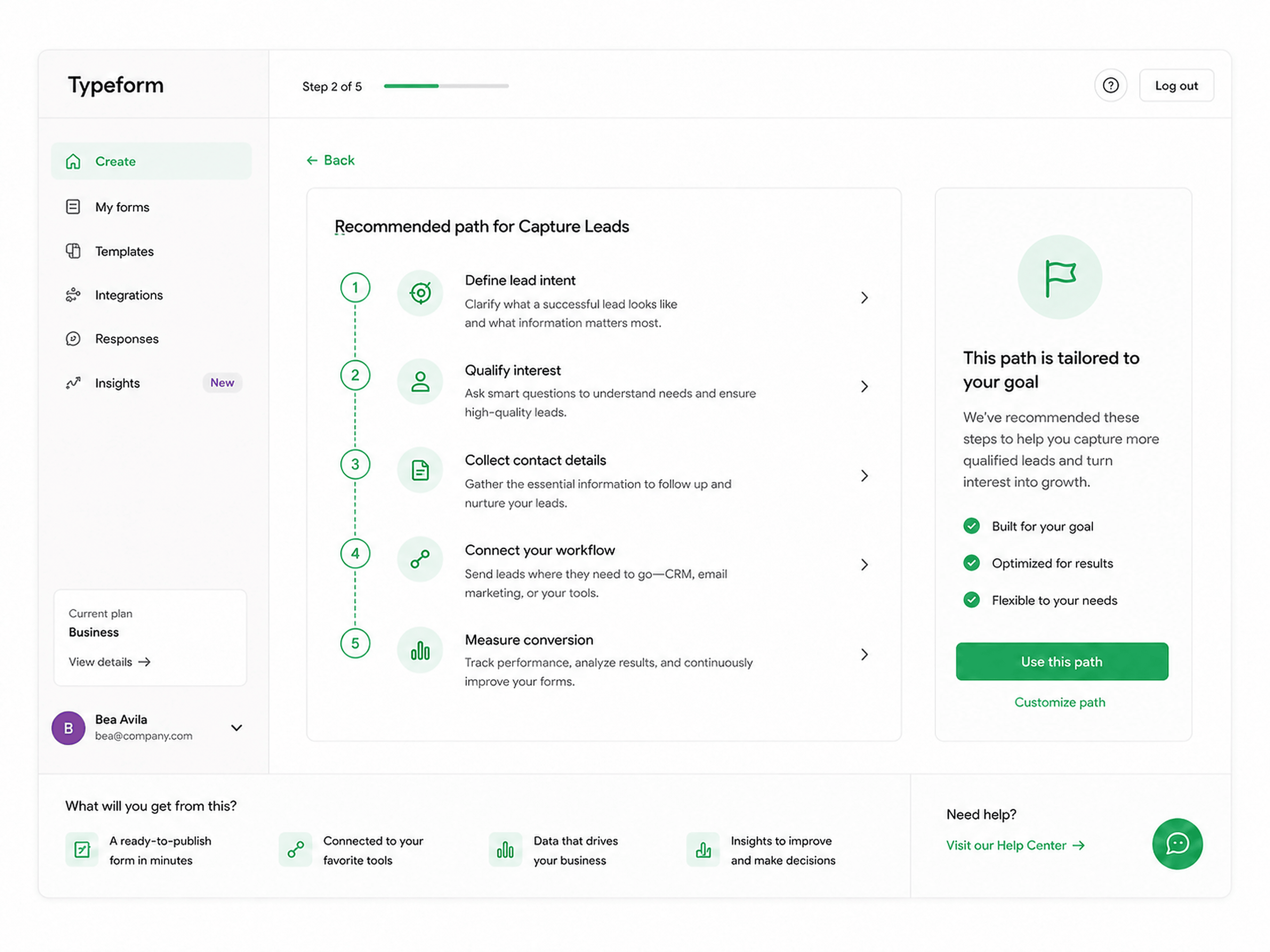
Screen 02 · Recommended path
The product translates that goal into a guided path: define intent, qualify interest, collect contact details, connect tools and measure conversion.
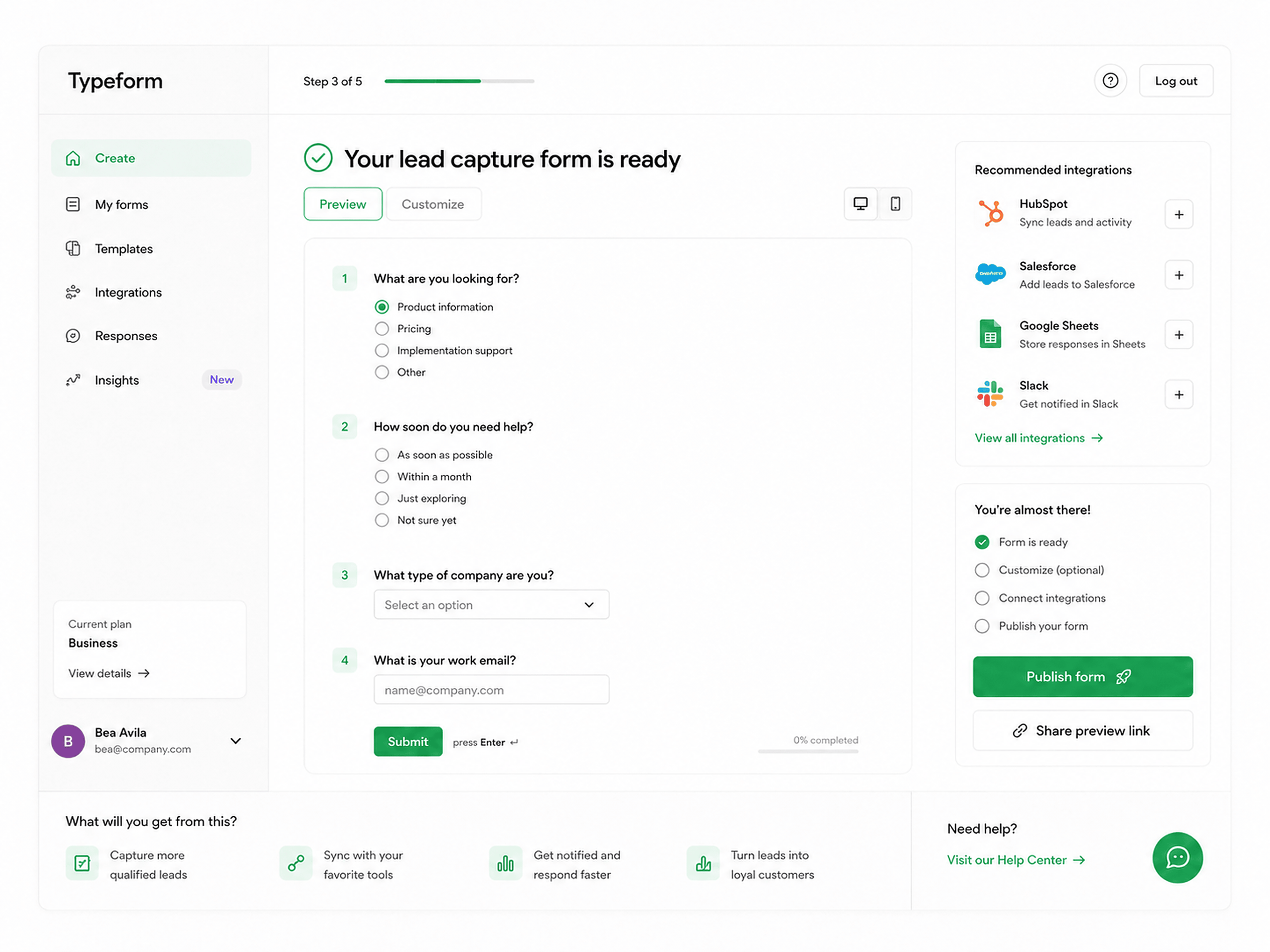
Screen 03 · First draft ready to publish
The system generates a publishable first version of the form, with a basic structure, recommended questions and suggested integrations.
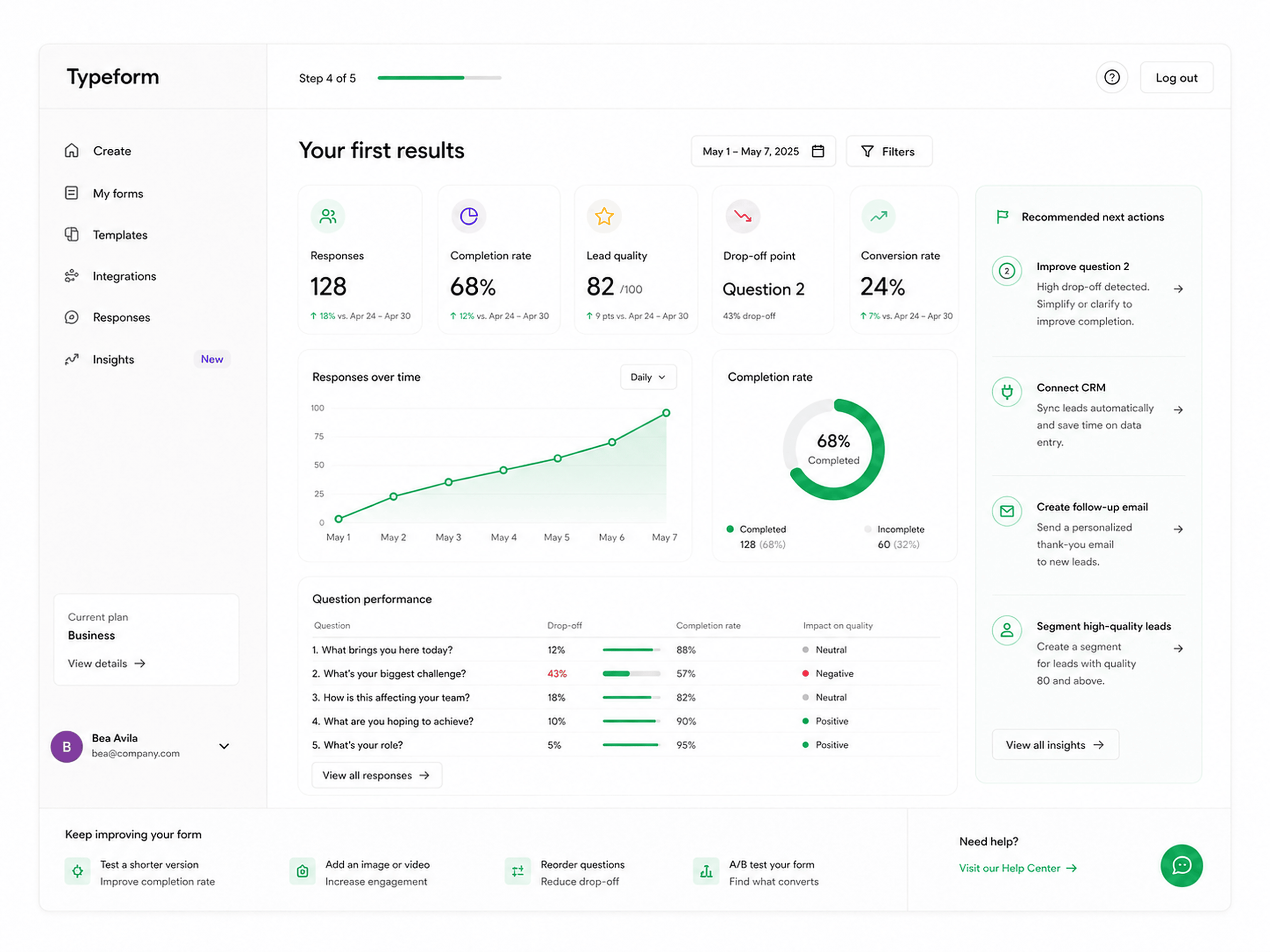
Screen 04 · First results
After publishing, the product helps interpret the first data and proposes concrete actions to improve: optimise a question, connect the CRM, create a follow-up email or segment higher-quality leads.
This sequence makes the case thesis visible: value does not appear when the user signs up, but when they move through the product with less friction and greater clarity.
What would need to be validated before implementation
Before a proposal of this kind could become a real product project, several aspects would need to be validated with the responsible product team: activation data, drop-off during onboarding, behaviour by user segment, priority use cases, conversion from sign-up to first published form, integration adoption, differences between free and paid accounts, retention metrics and the real needs of sales, marketing, research or support teams.
It would also be necessary to analyse which parts of the journey should be guided, what level of customisation should appear from the beginning and which decisions should be delayed in order to avoid increasing friction.
The purpose of this exercise is not to replace that process, but to show the kind of strategic questions that should guide it.
THE CONCEPTUAL DIRECTION
01 · Un Goal-first onboarding
The onboarding experience is built around the user’s goal, not the type of form they want to create.
Instead of starting with a screen focused on templates, formats or generic categories, the experience proposes paths based on intent:
capturing leads, collecting feedback, validating an idea, receiving requests, managing registrations, qualifying prospects or researching customers.
Each goal activates an initial recommendation: structure, questions, logic, integration and measurement.
The key is not to limit the product, but to help users make better decisions earlier.
02 · From blank page to guided path
One of the biggest friction points in flexible products is the beginning.
When users can do many things, they can also get stuck trying to decide where to start.
The proposal turns that first decision into a guided path. The user does not start from zero: they start from a useful hypothesis they can adjust.
For example, if they choose to capture leads, the system can suggest an initial structure: identify intent, qualify interest, measure urgency, collect contact details, connect with a CRM and measure conversion.
It is not a closed template. It is an intelligent starting point.
03 · First value before advanced customisation
In many SaaS products, customisation appears too early.
Colours, styles, advanced logic, conditions, integrations, design, automations, branding, settings and additional options can be highly valuable, but they can also slow activation if they appear before the user understands what they are building.
The proposal prioritises publishing a useful first version before opening every possible configuration option.
The goal is not for the first form to be perfect.
The goal is for it to exist, make sense, be connected and generate learning.
04 · Integrations as part of initial value
A form does not end when someone responds.
In many cases, the real value begins afterwards: when that response reaches the CRM, triggers a notification, adds a contact to a list, launches an automation or informs a commercial decision.
That is why integrations should not appear only as a later technical step.
In this concept, they are part of activation.
If the user is creating a lead capture form, connecting HubSpot, Salesforce, Google Sheets, Slack, Mailchimp, Zapier or a sales tool is not an extra. It is part of the value flow.
05 · Measurement after publishing
Publishing should not be the end of the first experience.
After publishing, users need to understand what is happening: how many people start the form, how many complete it, where they drop off, which source converts best, which responses are higher quality and what action should come next.
This measurement loop turns the first form into the beginning of a continuous improvement relationship.
It is not only about getting responses, it is about learning what to do with them.
Ecosystem architecture
A product experience that connects intent, creation, integration, publishing, measurement and continuous improvement.
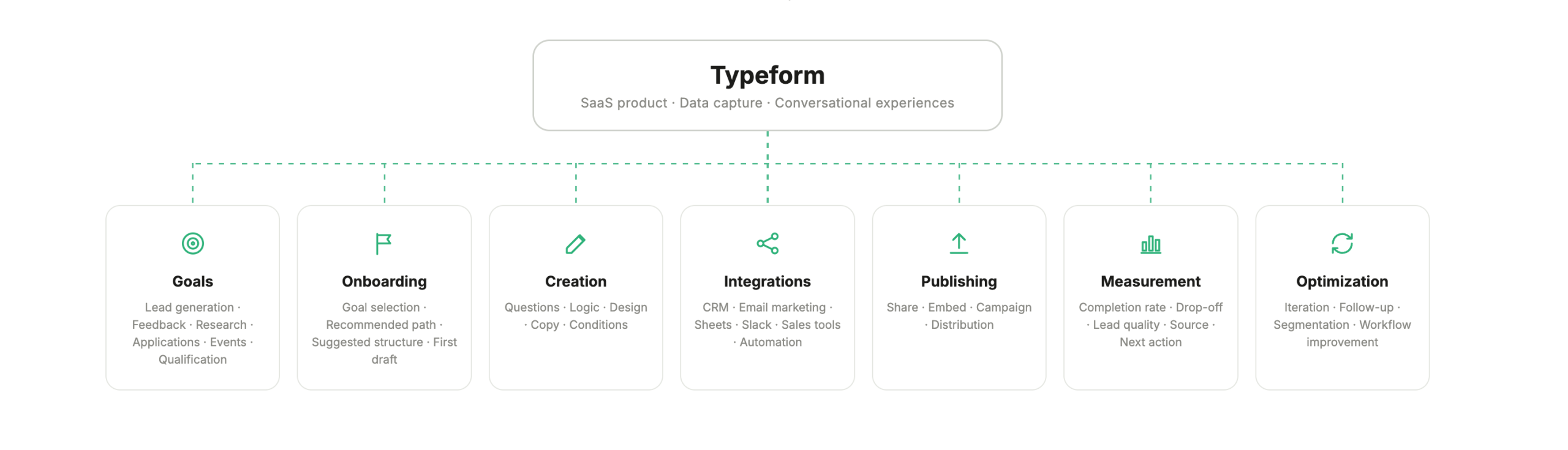
What changes with this proposal?
- •
A flexible product experience, but with too much translation left to the userTypeform allows users to create multiple types of forms and data-capture experiences. The opportunity is not to question that flexibility, but to observe what happens during the first minutes of use: users still need to translate their business goal into structure, questions, logic, integrations and metrics on their own.
- •
Templates help users get started, but do not always explain the journeyA template can reduce part of the initial friction, but it does not necessarily help users understand why that structure makes sense, what should be measured afterwards or how to connect the form with their real workflow.
- •
Integrations can be perceived as a later configuration stepIn many cases, the value of a form is not only in receiving responses. It is in what happens afterwards: sending a lead to the CRM, triggering a notification, adding a contact to a list, feeding an automation or starting a commercial action.
- •
Publishing can feel like the end of the processPublishing the first form is an important milestone, but in SaaS product logic it should be the beginning of a learning relationship: what works, where users drop off, how strong the responses are and what action should come next.
- •
Activation is treated as a step, not as a systemThe first experience can help users move forward, but the relationship between goal, structure, integrations, publishing and measurement is not always presented as one connected activation system.
- •
Goal-first onboardingThe experience starts by asking what the user wants to achieve, not what they want to create. This shift allows the first experience to be organised around intent rather than format.
- •
A guided path that reduces the blank page effectEach goal activates an initial structure, recommended questions, basic logic, relevant integrations and measurement signals. Users do not start from zero, but from a useful hypothesis they can adapt.
- •
Integrations as part of first valueCRM, email marketing, spreadsheets, Slack, sales tools or automations stop appearing as secondary configuration and become a natural part of the activation journey.
- •
Measurement from first useThe product helps users understand what happens after publishing: responses, completion rate, drop-off, lead quality, traffic source and recommended next actions.
- •
Activation as a system, not a screenThe proposal does not simply improve an interface. It organises a connected sequence that helps users move from intent to measurable value.
Key decisions
Pibeca’s role
Does your digital product lose users before they discover its value?
In many SaaS products, platforms and digital tools, the problem is not the idea or the visual design. It is the distance between sign-up, activation, real use and perceived value. At Pibeca Solutions, we help organise that experience: product strategy, UX, flows, integrations, automation and digital systems designed so users do not simply enter, but move forward.