

Case studies / Correos Business
Correos Business
A conceptual B2B experience designed to connect ecommerce, integrations, logistics, shipping, delivery and returns, helping each business build an operating model suited to its channels, volume and level of complexity.
This case study is an independent, non-affiliated conceptual exercise developed by Pibeca Solutions. There is no commercial relationship, collaboration or official commission from Correos, Grupo Correos, its subsidiaries, teams or partners. All trademarks, names, products, imagery and references belong to their respective owners. The purpose of this exercise is to explore how the digital experience for business customers could evolve through B2B strategy, service architecture, ecommerce, logistics, integrations and the relationship between selling, fulfilment, shipping, delivery and returns.
Strategic and conceptual direction: Beatriz Ávila.
We did not want to help a business choose a shipping product. We wanted to design an experience that could understand how that business operates and turn that context into a logistics architecture.
That decision shaped the entire concept.
Why this project exists
Correos Business offers far more than moving a parcel from one place to another. Its public business ecosystem includes parcel services, ecommerce solutions, integrations, marketplaces, APIs, collection and delivery points, Citypaq, returns and end-to-end logistics capabilities, among other services designed for companies.
In some scenarios, Correos can become part of the operation before a physical shipment even exists, by connecting sales channels, receiving order data or integrating with a customer’s systems. Its role may also continue after delivery, when an item needs to be returned and reintroduced into the logistics flow.
That makes the potential relationship with a business significantly broader than the purchase of a transport service. The challenge is that companies rarely think about their needs in terms of logistics products. They think about their own operation. They have a Shopify store, sell through several marketplaces, fulfil orders from their own warehouse, are beginning to expand outside Spain, need to automate repetitive processes or have discovered that returns are consuming too much time. In other cases, the problem appears when volume grows and the business is no longer sure whether it should continue handling storage and fulfilment internally or begin outsourcing part of the operation.
The customer usually understands the problem very well. What they may not know is which combination of products, platforms, contracts and integrations can solve it. That gap between the way a company understands its own business and the way a provider structures its portfolio is where the opportunity begins.
This project therefore does not start from the assumption that Correos needs more services. It starts with a different question: what would a digital experience look like if it could translate the way a company operates into the right combination of Correos solutions?
The conceptual opportunity is to introduce a new entry point within Correos Business. Instead of requiring customers to understand the portfolio before they can build a solution, the experience would begin by understanding how they sell, fulfil, integrate, ship and deliver. The goal is not simply to help them decide how to send an order, but to show how the entire chain might work from the moment an order enters the system through delivery, return and the operational changes that may become necessary as the business grows.
The challenge
The challenge was not to redesign the entire Correos website or replace the services, platforms, contracts or customer journeys that already exist. Nor was the objective to build a new logistics platform from scratch or assume that Correos does not already provide private tools for managing parts of this operation.
The challenge was to design a business experience capable of organising and connecting:
- •Ecommerce channels
- •Marketplaces
- •Plugin integrations
- •APIs
- •Internal systems and ERP platforms
- •Inventory
- •Warehousing
- •Order fulfilment
- •Parcel services
- •Domestic and international shipping
- •Post offices and collection points
- •Citypaq
- •Home delivery
- •Returns
- •Reverse logistics
- •Contracts
- •Identity and access
- •Operational data
- •Commercial processes
- •Operational scalability
Each of these capabilities can solve a specific need. Complexity appears when a company requires several of them at the same time and has to work out for itself which pieces are related, which are complementary, which depend on earlier steps and which are genuinely relevant to its operating model.
The proposal needed to preserve the depth of the portfolio without turning that depth into unnecessary complexity for the customer. An experienced business should still be able to go directly to the solution it already knows, while a company with a less defined requirement should be able to start from its own operational reality and receive meaningful guidance.
Not less capability. Better diagnosis, stronger connections between services and a clearer view of the operation as a whole.
Brand interpretation
Correos Business should not be understood only as a catalogue of transport and logistics services. Its public offering allows it to participate at different stages in the life of an order and, as a result, potentially across a much broader part of a company’s operation.
Before transport begins, there may already be an integration with an ecommerce platform or marketplace. Then come fulfilment, shipping documentation, transport and delivery. In some cases, the journey continues through returns and reverse logistics.
That makes the shipment itself too narrow a unit through which to explain the full potential value of the relationship. The more useful conceptual unit is the operation.
Before selecting a solution, a business needs to answer broader questions:
- •Where do we sell?
- •How many sales channels do we operate?
- •Where is our inventory held?
- •Who fulfils our orders?
- •How many orders do we process?
- •Which markets do we sell into?
- •What technology do we use?
- •Which processes need to be automated?
- •How do we want customers to receive their orders?
- •How do we currently manage returns?
- •Which parts of the operation should remain in-house?
- •Which parts could be outsourced?
- •What will need to change as volume grows?
The concept therefore operates across several tensions:
- •Logistics product and end-to-end operation
- •Portfolio and diagnosis
- •Self-service and expert support
- •Ecommerce and logistics
- •Physical process and digital system
- •Simple integration and advanced automation
- •Today’s operation and tomorrow’s growth
- •Independent channels and centralised management
- •Delivery and reverse logistics
- •Flexibility and contractual dependencies
The experience did not need to look more sophisticated by adding unnecessary dashboards or unsupported automated recommendations. It needed to demonstrate something much more useful: that a company can understand which pieces it needs, why they matter and how they can work together.
The strategic decision
The concept starts from one central idea: Correos Business would not simply be a place to select logistics products. It would introduce a layer capable of translating the customer’s operation into a service architecture.
The experience is organised around four connected stages.
Understand
The first stage is about understanding how the business currently works. The user can define sales channels, technology, approximate volume, markets, warehousing model, fulfilment process, delivery requirements and approach to returns.
This is not intended to become a long commercial questionnaire, nor an exercise in collecting information that might be useful later. Every question should exist because it materially changes the proposed configuration or helps the user understand a later dependency.
Design
Once the context is understood, the experience turns that information into an initial architecture. Identified needs are mapped to relevant services, integrations and capabilities within the Correos ecosystem.
The customer can see what is useful now, which options are complementary and which capabilities may not yet be necessary. The result is not a product list, but a map showing how the different pieces fit together.
Connect
The third stage makes the dependencies required to put the architecture into operation explicit. Contracts, Correos ID, plugins, APIs, portals, access permissions, integrations or other requirements can become part of a clear activation roadmap.
The customer therefore understands not only what they may need to contract, but also what needs to happen first, which steps depend on others and where specialist support may be required.
Scale
The final stage shows how the architecture could evolve as the business changes. A company may begin with a single ecommerce store, its own warehouse and a few hundred monthly orders, then later add marketplaces, enter new countries, automate processes or outsource part of fulfilment.
The experience should make those possible changes visible without suggesting that there is only one path to growth. The goal is to create an architecture that can adapt to increasing operational complexity rather than forcing the customer to rebuild everything from scratch.
The relationship therefore stops being organised purely around an isolated transaction and begins to support the evolution of the operation itself.
Methodology, assumptions and limitations
This case study is based exclusively on publicly available information about the Correos Business digital ecosystem, its ecommerce solutions, published integration capabilities, logistics services, delivery and collection models, return solutions and the publicly documented requirements for certain contracting and activation processes.
The proposal does not include access to:
- •Internal analytics
- •User research conducted by Correos
- •Technology architecture
- •Product roadmap
- •Operational data
- •Actual volumes by customer segment
- •Internal sales processes
- •Conversion rates
- •Private tools currently available to customers
- •Active customer integrations
- •Actual capacity by logistics centre
- •Contractual models
- •Negotiated pricing structures
- •Service-level agreements
- •Implementation costs
- •Regulatory constraints
- •Internal support processes
- •Strategic priorities
- •Requirements expressed directly by Correos or its customers
The concept should therefore be read as a working hypothesis. It does not assume that current systems are technically disconnected or that Correos lacks tools for centralising parts of the operation.
Nor does it assume that every service can be combined with every other service, that all capabilities are available in every market or that the recommendation logic proposed here could be defined from public information alone. Real-world complexity may be shaped by commercial, technological, operational or contractual decisions that are not visible externally.
The purpose of the exercise is to explore how a diagnostic and guidance layer could connect business needs with existing services while preserving the depth of each solution and reducing the effort required to understand how those solutions might form part of a broader operating model.
How success would be measured
As this is a conceptual exercise, any metric would need to be validated against real business objectives, internal data and an agreed baseline. Even so, the experience could be evaluated across five dimensions.
Discovery
At this stage, useful measures would include the time required to identify a suitable configuration, adoption of the guided journey, services discovered through the diagnostic process, understanding of the relationships between services and abandonment throughout the flow. It would also be valuable to understand whether customers reach a relevant solution more quickly when they begin with their operation rather than with a product category.
Conversion
Conversion could be assessed through completed configurations, assisted-sales requests, lead quality, adoption of related services and conversion by operating model. The goal would not simply be to increase the number of enquiries, but to ensure that those enquiries arrive with clearer context and a better-defined need.
Activation
This phase could measure how long it takes to complete the requirements needed to begin operating: account creation, contracts, plugin installation, platform access, returns configuration, API requests or the first successful integration. It would also help identify which dependencies create the greatest friction and where clearer guidance is needed.
Operation
Where products and data allow, the experience could track processed orders, generated shipments, deliveries, incidents, returns, collection-point usage, process automation and integration adoption. The value of a logistics architecture is not proven at the point of purchase, but in its ability to operate reliably within the business.
Scalability
It would also be useful to observe when a company adds new channels, markets, integrations or services, what configuration changes occur as the business grows and which signals indicate that the architecture should evolve. The platform could therefore become a continuity tool as well as an activation tool.
Success would not depend only on lead volume or contracted services. It would depend on the experience’s ability to shorten the distance between “this is how our business works” and “this is the infrastructure we need”.
From hypothesis to product experience
To make the proposal tangible, the case develops a conceptual sequence of screens covering the main stages of the new journey.
The objective is not to redesign every Correos digital product or assume that every capability needs to be technically unified into one platform. Instead, the sequence explores how a diagnostic, architectural and continuity layer could connect services that currently address different stages of the operation.
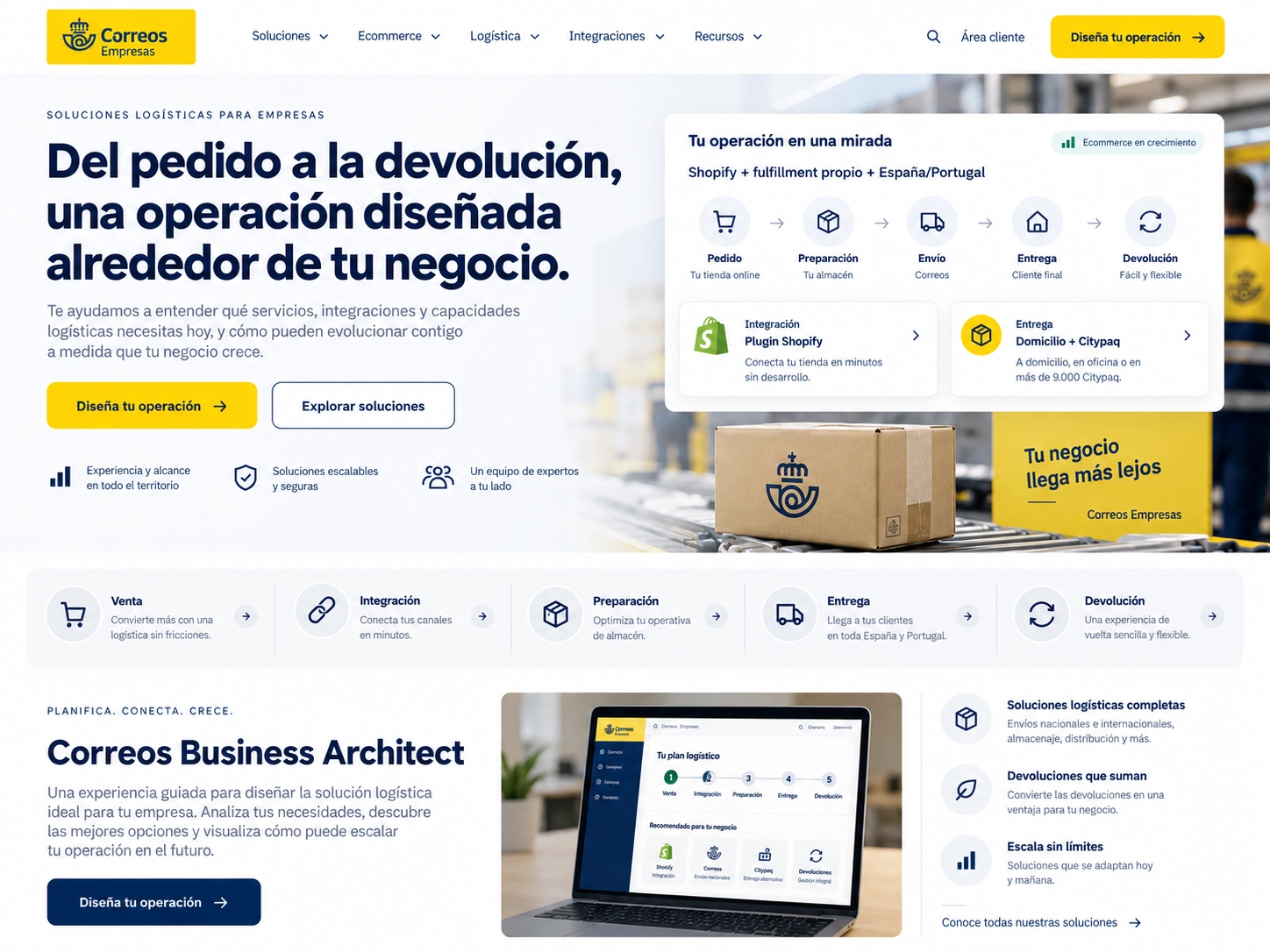
Screen 01 · Correos Business homepage
Businesses can still enter directly through shipping, ecommerce, logistics or other existing areas, but the experience introduces an additional route: Design your operation. The hero no longer starts by asking which product the company wants to buy. It starts with how the company sells, fulfils and delivers. Direct access to the portfolio remains available, while the guided route supports customers who understand their need but not necessarily the structure of the ecosystem.
Screen 02 · Business Architect
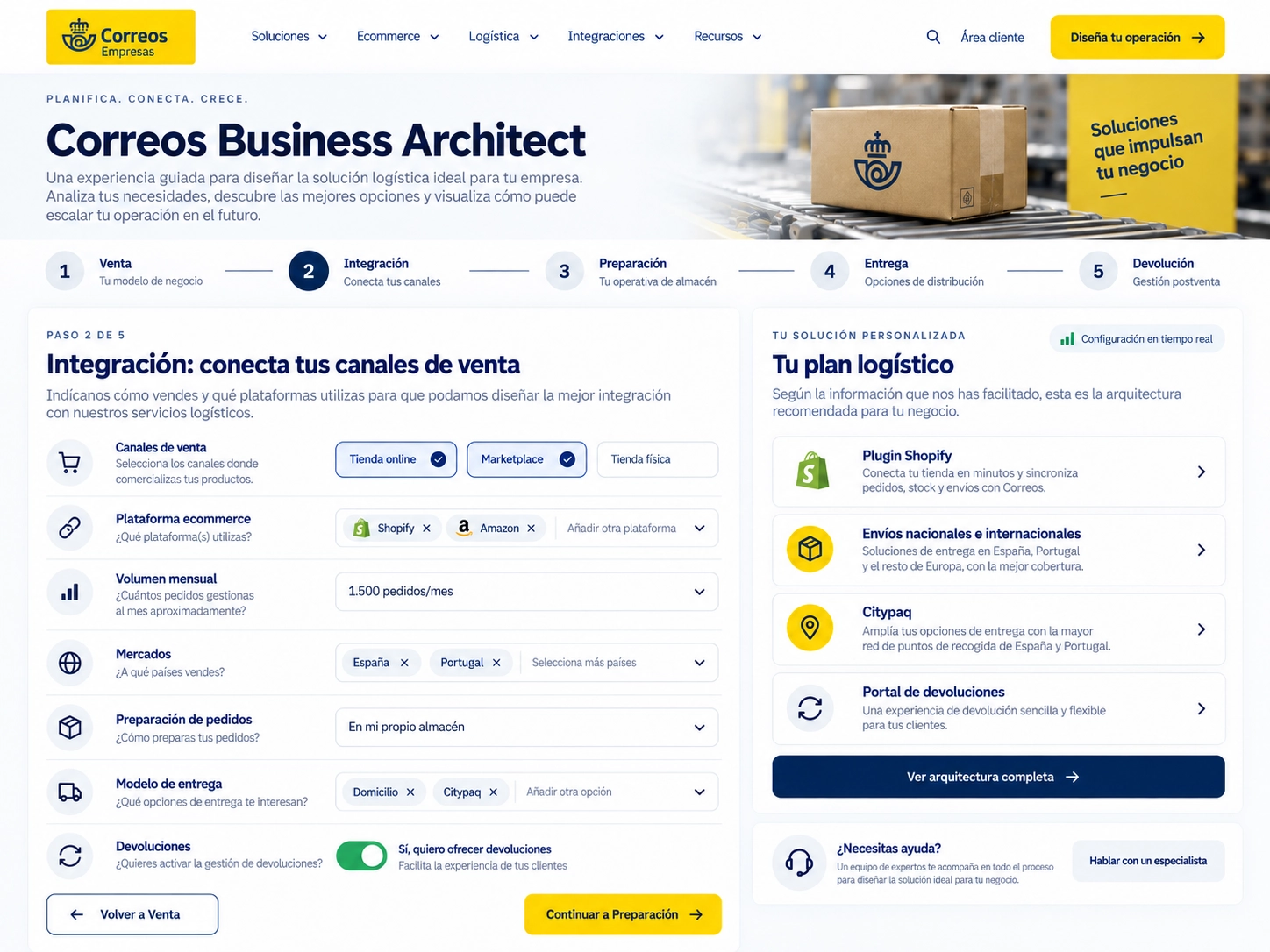
A guided configurator explores sales channels, technology, inventory, fulfilment, volume, markets, delivery and returns. Each answer changes the configuration and helps explain why a particular solution may be relevant. The user can understand the recommendation logic as it develops rather than receiving an opaque result at the end.
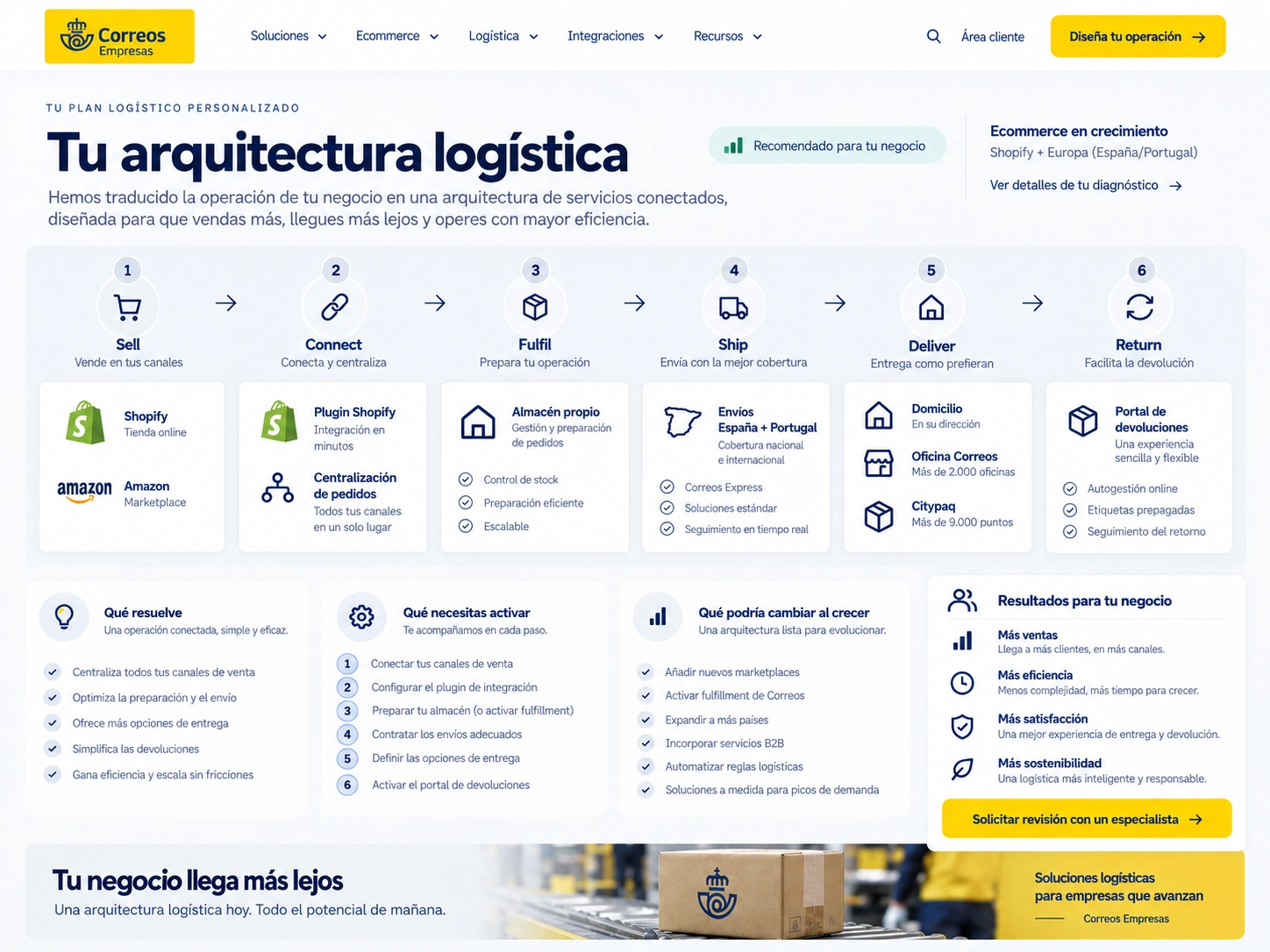
Screen 03 · Recommended architecture
The user receives an initial map connecting selling, integration, fulfilment, shipping, delivery and returns. Products are shown within the operation rather than as independent purchasing decisions. Each component explains what it solves, what it requires and which alternatives may be more appropriate at different levels of complexity.
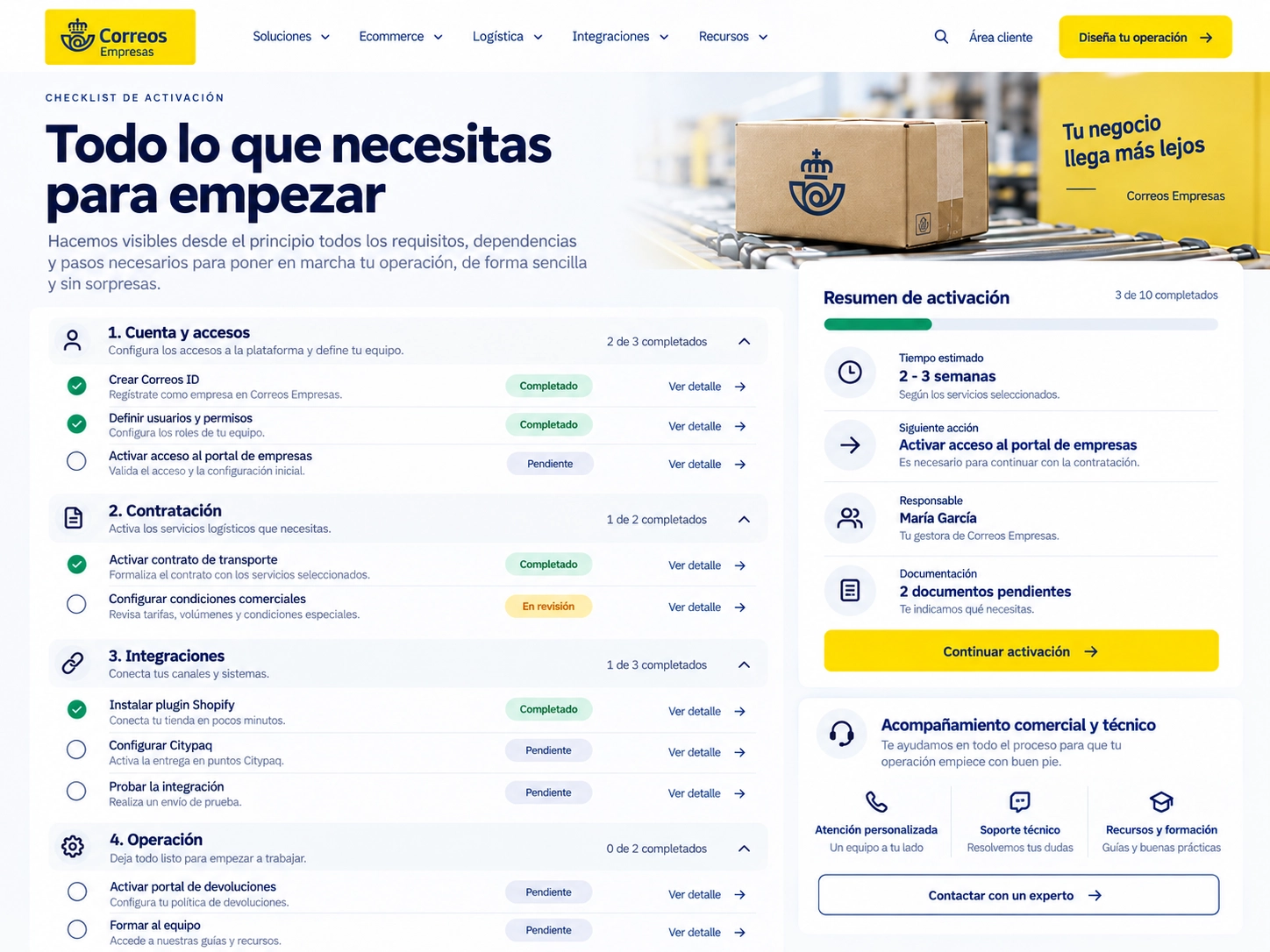
Screen 04 · Activation checklist
The experience shows which requirements must be completed before the architecture can operate: accounts, contracts, plugins, APIs, portals, integrations or commercial setup. The goal is to reduce uncertainty and make it clear which steps can be completed independently and where specialist support is required.
Screen 05 · Growth scenarios
The system shows both the current configuration and possible future states as order volume increases, new markets are added, channel complexity grows or the company outsources part of its operation. These are not presented as fixed predictions, but as a way to understand how the architecture might need to change when the business changes.
Screen 06 · Operational workspace
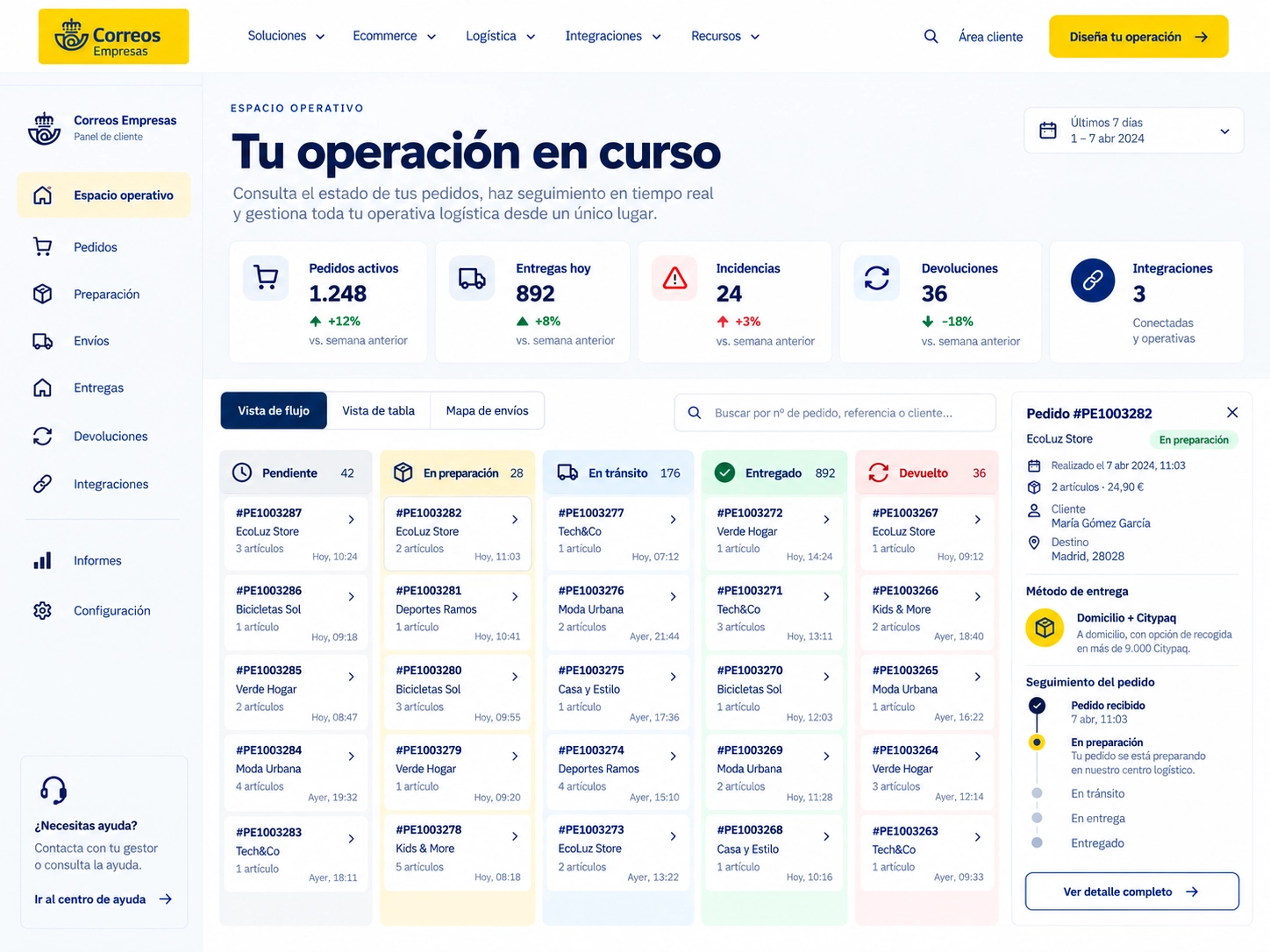
Conceptually, businesses could view orders, fulfilment, shipments, deliveries, incidents, returns and integrations through a common operational structure where available tools and data make this possible. The objective is not to replace specialist systems, but to preserve context across different stages of the operation.
Screen 07 · Commercial handoff
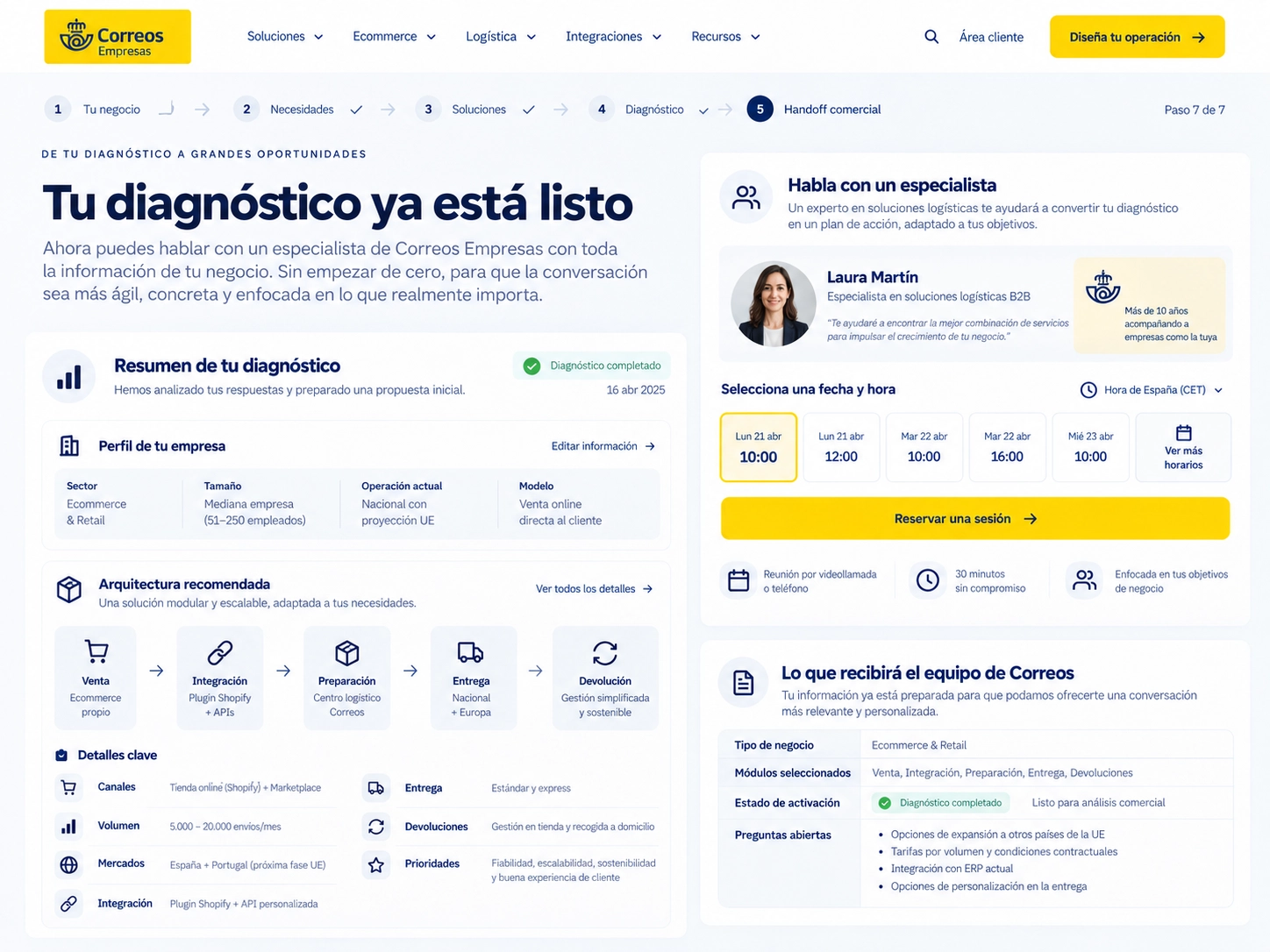
If the configuration requires expert support, the conversation with Correos begins with context. The specialist could receive information about volume, channels, markets, integrations, identified needs and the preliminary architecture, preventing the customer from having to start again after completing the diagnostic process.
This sequence makes the core thesis of the case visible: the value does not come from placing every Correos service inside a single screen, but from preserving context as the customer moves from a need to a solution, from a solution to an integration, and from today’s configuration to a more complex operation.
What would need to be validated before implementation
Before a concept of this kind could become a real product, it would need to be validated with Correos and with businesses operating under very different logistics models. A small ecommerce company processing a few hundred monthly orders cannot be designed for in the same way as an omnichannel retailer operating across several warehouses, marketplaces, countries and internal systems.
The validation process would need to cover:
- •Priority customer segments
- •Operating models
- •Compatibility between services
- •Contractual dependencies
- •Minimum and maximum volumes
- •Geographical coverage
- •Pricing models
- •Onboarding processes
- •Correos ID
- •Transport contracts
- •Plugin integrations
- •API processes
- •Supported marketplaces
- •ERP and ecommerce systems
- •Fulfilment capabilities
- •Inventory management
- •Return processes
- •International differences
- •Permissions and security
- •Data protection
- •Existing business tools
- •Data migration
- •Training and support
- •Adoption
- •Operational capacity
- •Experience governance
That process should combine customer research, data analysis, commercial and operational process reviews, technical validation and usability testing. The objective would not be to prove the concept exactly as presented here, but to determine which parts genuinely create value, which may already be solved by existing systems and how much guidance can be introduced without oversimplifying an operation that is inherently complex.
This exercise is not intended to replace that process, but to make the questions that should shape it visible.
THE CONCEPTUAL DIRECTION
01 · Visual direction
The visual direction starts with one important decision: Correos Business should not be redesigned to look like a logistics startup trying to distance itself from the Correos brand. Correos already has strong recognition, highly distinctive visual assets and an immediate association with distribution, proximity and infrastructure. The opportunity was to bring those codes into a more operational and digital experience.
The experience needed to communicate:
- •Clarity
- •Capability
- •Movement
- •Reliability
- •Traceability
- •Scalability
- •Control
Correos yellow
It remains the strongest brand signal, particularly across discovery moments, calls to action and areas where immediate brand recognition matters. Rather than becoming a constant background across the entire interface, it is used selectively to create hierarchy and preserve the visual identity of Correos.
Deep blue
It introduces structure, contrast and a more business-oriented, technological layer. It can support navigation, product interfaces, configurators and areas with greater information density, helping distinguish operational functionality from more promotional communication.
Light neutral backgrounds
These create space for configurations, steps, requirements, status information and data without competing with the corporate yellow. They also help information-heavy interfaces remain legible and calm.
Operational photography
The visual language should go beyond parcels, vans and delivery staff. Photography can include warehouses, fulfilment, ecommerce operations, collection points, businesses, technology and customer environments. The protagonist is no longer only the parcel, but the operation that allows that parcel to move successfully through the system.
Process diagrams
The sequence order → fulfilment → shipping → delivery → return becomes a recurring visual device. It makes complex relationships easier to understand and helps preserve context between different parts of the journey.
Functional iconography
Channels, warehouses, integrations, transport, delivery and returns should be easy to recognise at a glance. Icons support structure, status and action rather than functioning as decoration.
Sans-serif typography
Clear, contemporary and flexible enough to work across large headlines, forms, tables, checklists and dashboards. The typography needs to support both brand communication and the density of an enterprise product.
The overall experience was intended to feel like a combination of:
- •Logistics infrastructure
- •B2B digital product
- •Operations tool
- •Business service
- •A familiar and recognisable brand
02 · The homepage concept
The concept does not replace the existing Correos Business homepage. It introduces a second logic that sits alongside direct access to the portfolio.
Visitors who already know exactly which service they need can continue to access it immediately. Those who arrive with an operational problem can instead begin somewhere else: design your operation.
The hero introduces the promise: from order to return, an operation built around your business.
From there, the page introduces the key stages of the chain — selling, integration, inventory, fulfilment, shipping, delivery and returns — and makes it visible that Correos can participate at different points.
The homepage does not attempt to explain every service in depth. Its purpose is to communicate the breadth of the ecosystem and offer a guided route to businesses that need to build a solution rather than select a known product.
Direct routes into ecommerce, logistics, shipping, returns and integrations remain available. The configurator is a layer of guidance, not a mandatory gateway.
03 · A guidance layer, not another website
Correos Business Architect is not conceived as an independent brand or a disconnected microsite. It sits within Correos Business and shares its identity, products, services, account structure, contracts, platforms, support and documentation.
What changes is the entry logic. The portfolio allows users to go directly to individual capabilities. Business Architect translates the customer’s operational reality into that portfolio.
A user can move from a need to a solution, and from that solution to the other components required to make it work.
This avoids unnecessary duplication of content and systems. The new layer does not replace the existing ecosystem.
It diagnoses, structures and connects it.
04 · Understand the business before recommending the product
One of the central decisions was not to begin by asking which Correos product the user wants to buy.
The diagnostic journey explores sales channels, ecommerce platforms, marketplaces, product type, order volume, markets, stock, warehouses, fulfilment, delivery models, returns, internal systems, level of automation and growth plans.
The aim is not to turn the experience into an interrogation. Every question should have a reason to exist: it should change the recommendation, expose a dependency or materially improve the later commercial conversation.
The depth of the diagnostic can also adapt. A simple operation should not need to answer the same number of questions as a business with multiple channels, markets and internal systems.
At any point, the user should still be able to leave the guided path and explore the portfolio directly.
Guidance should reduce friction, not create another one.
05 · The recommended logistics architecture
The primary output of the diagnostic is not a submitted form. It is an architecture.
A business might receive, for example, a configuration in which Shopify and several marketplaces function as sales channels, a plugin provides the initial integration, orders continue to be fulfilled from an in-house warehouse, shipping combines domestic and international services, customers can choose home delivery or collection points, and returns are handled through the relevant returns tools.
The architecture could also introduce possible future changes, such as moving to API integration once volume and automation increase or exploring outsourced fulfilment if internal preparation becomes inefficient.
Each component should explain what it solves, why it appears in the architecture, what it needs to operate, which alternatives exist and what may change later.
The customer understands the system before having to contract it.
A useful recommendation should also be able to say what the business does not need yet. The purpose is not to maximise the number of products sold, but to identify the combination that makes sense for a specific operating model.
06 · Dependencies made visible
A B2B architecture is made of more than features. It also depends on contracts, accounts, permissions, integrations and relationships between systems.
The proposal therefore introduces an activation checklist capable of explaining which services can be enabled directly, which require a contract, which depend on Correos ID, when technical integration is required, where the Developer Portal may become relevant and which steps require commercial intervention.
The complexity does not disappear. It becomes understandable.
At any point, the customer should be able to answer four simple questions: what do we already have, what are we missing, what should happen next and who needs to act?
Making these dependencies visible early avoids a familiar B2B problem: reaching an apparently suitable solution and only later discovering several additional requirements that were not obvious at the point of selection.
07 · Designing for the current operation and the next one
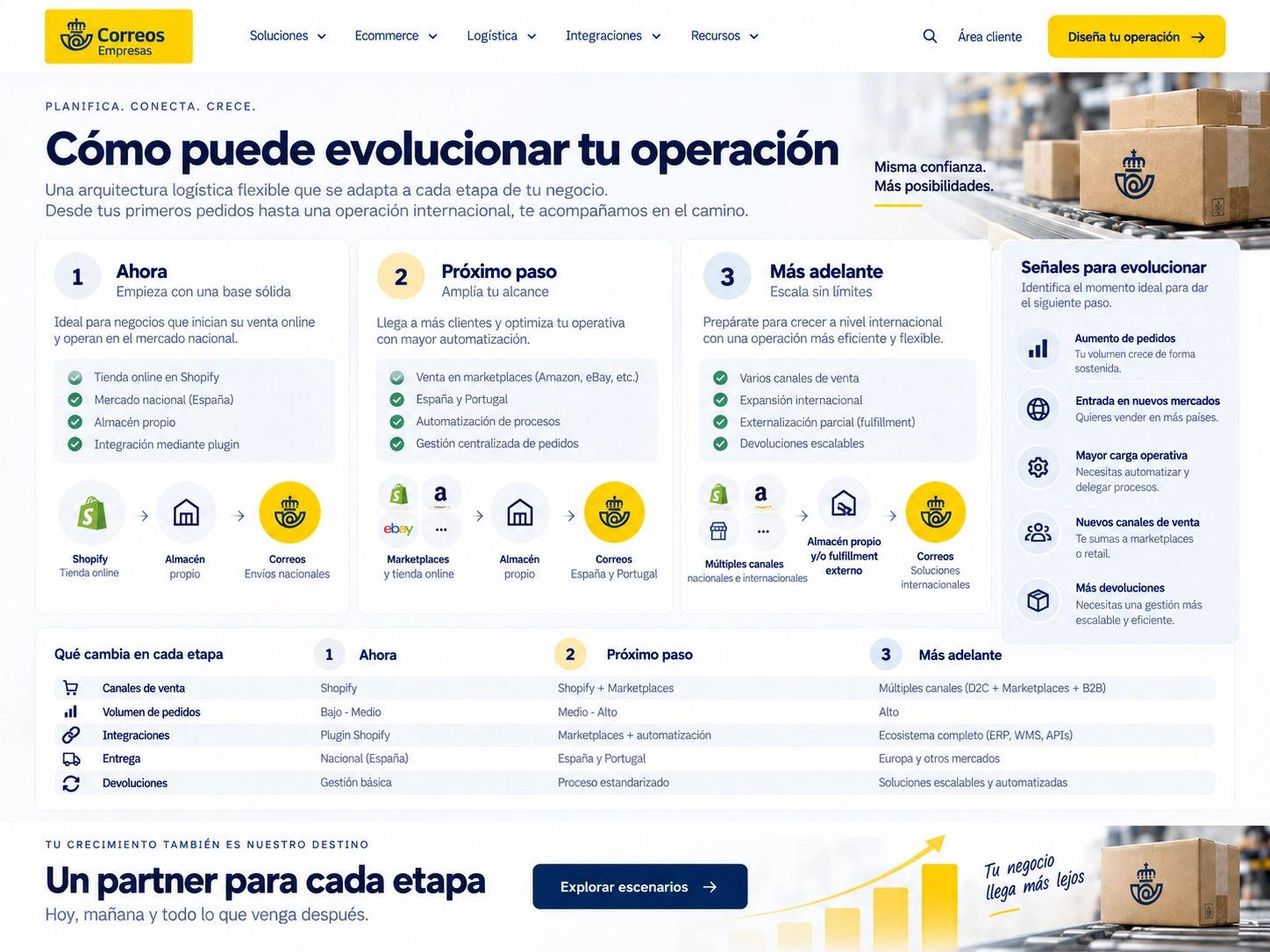
The architecture that works today may be insufficient twelve months from now. The concept therefore introduces scenarios that show how the operating model might change as the business grows.
A company running Shopify, selling domestically, fulfilling from its own warehouse and processing a moderate volume may begin with a relatively simple setup. As orders increase, it may require more automation. Adding marketplaces may create a need for channel centralisation. Entering new countries changes shipping requirements. Outsourcing part of fulfilment introduces warehousing, inventory and reverse-logistics considerations.
The system does not assume that every company should follow the same path or that growth necessarily means outsourcing. The scenarios simply make visible which variables can cause the current architecture to stop being the most appropriate one.
The architecture becomes less of a static recommendation and more of a representation of how the business may evolve.
08 · From shipment to the full order lifecycle
The experience is organised around a recognisable operational sequence:
Sell · Connect · Fulfil · Ship · Deliver · Return
Sell represents where the order originates. Connect explains how that order reaches the logistics system. Fulfil introduces stock and preparation. Ship covers transport. Deliver focuses on how the customer receives the order. Return incorporates what happens when the product comes back.
This sequence helps relate capabilities that might otherwise appear independent. It also gives the customer a simple mental model for understanding where each Correos service sits.
Instead of memorising the portfolio, the user can follow the life of their own order.
09 · The operational workspace
The concept also explores how the relationship with Correos could be read through a shared operational layer, where existing tools and available data make that possible.
The workspace could bring together orders, fulfilment, inventory, shipments, deliveries, incidents, returns, integrations, documentation and activation status, but the objective is not to create a decorative dashboard.
Every piece of information should answer a question or enable an action. The user should be able to see which orders are still pending, which shipment has an issue, which return is currently in transit, which integration has stopped synchronising or which process requires intervention.
The value lies in continuity. The customer should not need to reconstruct the context every time they move from one stage to another.
This does not necessarily mean replacing specialist platforms or building a monolithic system. A shared layer can preserve context while specialised products continue to provide the depth they require.
10 · Returns as part of the system
Returns are not treated as an isolated exception that happens after the sale. They are part of the architecture from the beginning.
The experience can help define how customers initiate a return, how they receive the necessary documentation, where they hand over the parcel, how collection takes place, how the item travels back, how the ecommerce platform is updated and what happens when the product returns to inventory.
Not every step will be controlled exclusively by Correos. That is precisely why it is useful to represent the process as a shared operational journey and make the boundaries of responsibility clear.
Reverse logistics affects cost, customer experience, stock and operations. Designing it from the beginning prevents it from becoming an improvised process once return volumes begin to increase.
11 · Integrations as part of the experience
An integration should not appear only as technical documentation.
From a business perspective, integration means that an order can enter automatically, a shipping label can be generated without manual intervention, a status can return to the customer’s system or a return can update the ecommerce platform.
The concept therefore contextualises plugins, marketplaces and APIs according to order volume, technology, number of channels, level of automation, technical capacity and operational complexity.
The customer should not have to decide whether they “want an API”.
They should understand what problem an API would solve in their specific operation, what it requires and when it begins to make sense compared with a simpler alternative.
This connects technical decisions with operational and commercial outcomes.
12 · The commercial handoff
The digital experience is not intended to replace Correos specialists.
It is intended to make the conversation better.
When a configuration requires expert support, the commercial team could receive information on business type, channels, order volume, markets, technology, fulfilment model, delivery requirements, returns, integrations, explored services, preliminary architecture and identified priorities.
The customer does not need to explain everything again from the beginning, and the specialist can start directly with the decisions that still need validation.
The diagnostic therefore creates value in both directions. The customer receives useful guidance before speaking to sales and Correos receives a lead with significantly more context.
Lead generation becomes an exchange of value rather than a simple collection of contact information.
13 · Adoption and operation
A B2B architecture can be strategically correct and still fail if implementation is difficult. The concept therefore considers onboarding, account configuration, contracts, credentials, plugin installation, API access, integrations, data migration, user setup, training, support, monitoring and ongoing maintenance.
Responsibilities also need to be defined. Who maintains each integration? Who resolves errors? Who updates permissions? How are service changes handled? What happens when volume or the operating model changes?
These decisions are as important as the initial interface design. The objective would not simply be to create the right architecture. It would be to ensure that the architecture can be implemented, maintained and evolved reliably
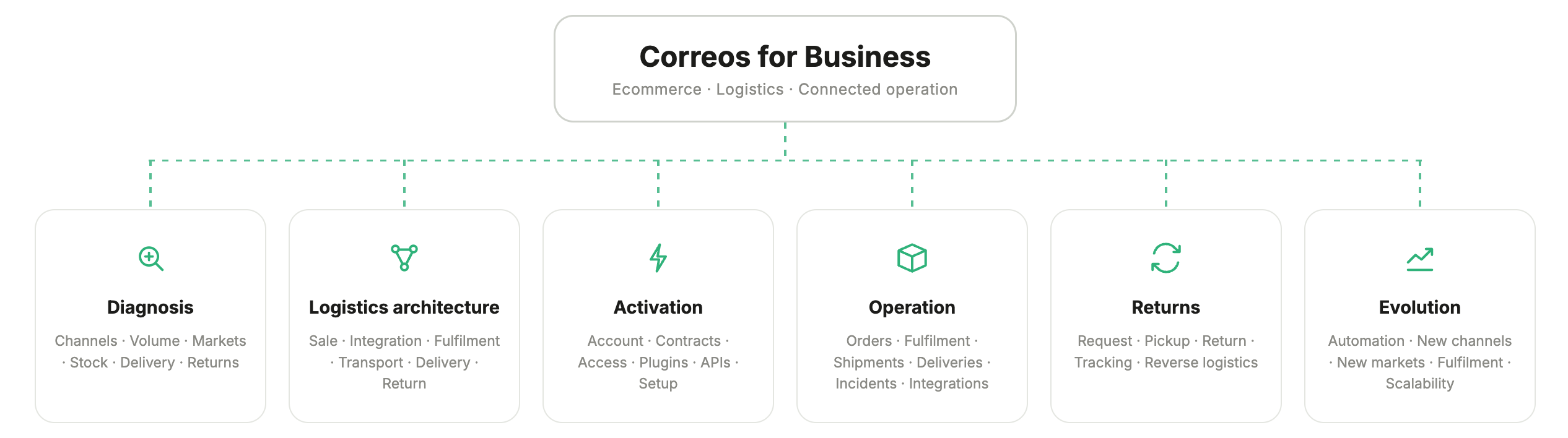
Ecosystem architecture
An experience that connects business, channels, systems, fulfillment, transportation, delivery, returns, and operational evolution.
What changes with this proposal?
- •
The experience is structured primarily around the Correos portfolioCustomers can access parcel services, ecommerce, integrations, logistics, Citypaq, returns and other specialist solutions. The breadth of the offer is a strength, but businesses may still need to work out which combination best fits their operation.
- •
Each product addresses a specific needPlugins, APIs, logistics services, shipping and returns each provide valuable capabilities, but combining several of them may require prior knowledge, exploration and a clear understanding of how they fit into the wider operation.
- •
The customer translates the problem into the portfolioThe business begins with an operational reality — channels, volume, stock, fulfilment, markets or returns — and must identify which Correos products and services correspond to that situation.
- •
Requirements are explained within individual servicesContracts, access, platforms and integrations are presented within separate journeys, which means dependencies may only become visible as the customer progresses through each solution.
- •
Contracting primarily solves the current requirementThe customer identifies a specific need and contracts a service or requests information, while the relationship with other capabilities or future operational changes may not yet be obvious.
- •
The operation may span different systems and momentsOrders, fulfilment, shipping, delivery and returns may rely on different tools, processes or platforms, requiring the customer to preserve or rebuild the context as they move between them.
- •
A new entry point built around the operationCorreos Business retains its portfolio and direct routes into individual services, while adding an experience that begins with how the company actually works: where it sells, how it fulfils, what volume it manages, how it delivers and what it needs to solve.
- •
Services become an architectureEcommerce, integration, fulfilment, shipping, delivery and returns are no longer presented only as separate capabilities. They are also shown as parts of a system that can be configured around the customer’s operation.
- •
Correos translates needs into solutionsThe company describes its context and receives an initial configuration showing which capabilities may be relevant, why they appear and how they can work together.
- •
Dependencies become visibleAccounts, contracts, plugins, APIs, portals, integrations and specialist support become part of an activation roadmap that makes it clear what is ready, what is missing and what needs to happen next.
- •
The architecture is designed to evolveThe company can see how its configuration might change as volume, channels, markets, automation or outsourced fulfilment increase, without having to rebuild the solution from scratch.
- •
The order keeps its contextThe experience connects the different stages of the operation around the same journey, from order creation through delivery or return, improving continuity between processes, systems and decisions.
Key decisions
Pibeca's contribution
Does your business offer solutions, or help customers build operations?
We design B2B digital ecosystems that connect services, ecommerce, technology, operations and data. Platforms that do not force customers to understand how the provider is organised before they can solve their own problem, but begin by understanding how their business actually works.