

Case Studies / Victoria Beckham
Victoria Beckham
We designed a digital architecture built around two complementary conceptual lines: a central brand hub to organise her public figure, brands and cultural narrative; and an evolution of her ecommerce experience to elevate fashion, beauty and product discovery.
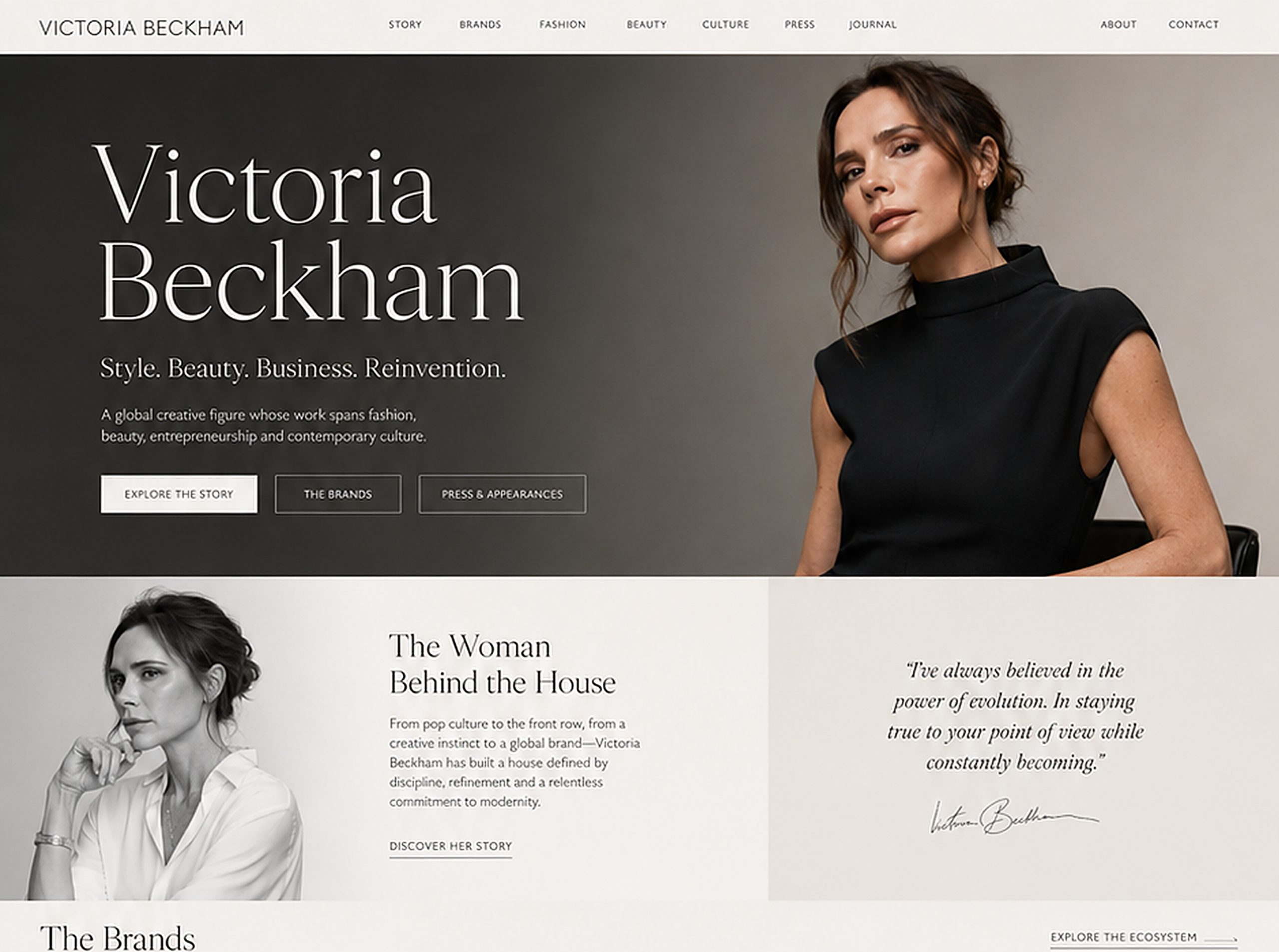
This case study is an unaffiliated conceptual exercise developed by Pibeca Solutions. There is no commercial relationship, collaboration or official assignment from Victoria Beckham, Victoria Beckham Holdings, Victoria Beckham Beauty, Victoria Beckham Fashion or their teams. All brands, names, images and references mentioned belong to their respective owners. Its purpose is to explore opportunities in digital strategy, brand narrative, UX, content structure and web experience based on a public figure and her brand ecosystem.
Strategic and conceptual direction: Beatriz Ávila.
Two websites, two roles: one builds authority, the other turns desire into purchase.
That was the strategic decision behind the entire exercise.
The challenge
Victoria Beckham does not have a visibility problem. Her notoriety already exists. The challenge lies in structuring a personal brand that has evolved into fashion, beauty, business and contemporary culture.
Without a clear digital architecture, the risk is that everything remains dependent on the public figure herself, while fashion, beauty, press, ecommerce and institutional storytelling compete for attention.
The brand needed a digital ecosystem capable of separating functions without fragmenting the identity.
Our perspective
We identified two complementary needs: to build cultural and personal authority through a central brand hub, and to convert interest into purchase through a more editorial, aspirational and product-focused ecommerce experience.
The key was not to choose between personal brand and ecommerce. It was to design a system where both dimensions could coexist with clarity, sophistication and a shared identity.
Before designing: what needed to be organised
Before designing screens, the first step was to understand which layers coexist within the Victoria Beckham ecosystem.
This is not only a fashion brand, not only a public figure and not only an ecommerce experience. It is a combination of personal history, creative direction, fashion, beauty, cultural presence, press, collaborations, product and business.
That is why the initial challenge was not to choose an aesthetic. It was to identify what each digital piece needed to organise and what role it should play within the system.
An architecture of this kind needed to consider several dimensions:
Public figure
Personal history, media presence, interviews, appearances and cultural relevance.
Fashion brand
Collections, campaigns, shows, iconic pieces, lookbooks and ecommerce.
Beauty
Product, ingredients, rituals, science, editorial tone and sensory experience.
Business
Growth, internationalisation, collaborations, team, partners and perception of solidity.
Audiences
Customers, press, followers, partners, beauty consumers, creative teams and international audiences.
Legacy
Reinvention, creative authority and the construction of a brand with a life beyond the original celebrity.
The conclusion was clear: a single website could show everything, but it could hardly organise everything with the same clarity.
Why not one single website
The temptation with a brand of this kind would be to try to solve everything in one single website: story, product, ecommerce, beauty, press, collaborations, editorial content and institutional vision.
But when a website tries to serve too many functions at once, one of two things usually happens: either it becomes too commercial and loses brand depth, or it becomes too institutional and makes conversion more difficult.
That is why the strategic decision was to separate functions without fragmenting identity.
The brand hub builds authority.
The ecommerce builds desire and purchase.
The architecture connects both experiences under one shared brand universe.
Separation did not mean division. It meant allowing each part to do its job better.
The brand hub organises the figure, the story, the vision, the brands, the press and the cultural relevance.
The ecommerce organises product, campaigns, categories, recommendations, beauty, accessories and purchase journeys.
The combined system allows an audience to enter through the story, product, press or beauty without losing overall coherence.
Methodology, assumptions and limits
This case study was developed as an unsolicited conceptual exercise, based on publicly available information about Victoria Beckham, her brands, her digital presence, her ecommerce experience, her visual universe and her positioning.
We did not work from an internal brief, private data, real analytics, interviews with brand teams or access to commercial or technological objectives. Therefore, the proposal does not intend to replace an official strategy or make claims about the company’s internal needs.
The methodology was based on four steps:
01 · Brand reading
Analysis of Victoria Beckham’s public evolution as a cultural figure, founder, creative director and brand associated with fashion, beauty and contemporary style.
02 · Digital ecosystem analysis
Identification of the main functions her online presence should fulfil: authority, product, ecommerce, press, editorial content, beauty, culture and collaborations.
03 · Audience and intention definition
Separation of journeys according to user type: fashion customer, beauty consumer, journalist, partner, follower, potential investor or cultural audience.
04 · Conceptual architecture proposal
Design of two complementary digital lines: a central brand hub to build context and authority, and an ecommerce evolution to reinforce product, desire and conversion.
The main limitation of the exercise is clear: without internal data, we cannot validate commercial priorities, category performance, operational needs or technical constraints. For that reason, the value of the case is not in presenting a closed solution, but in showing a possible strategic reading of the ecosystem and how it could translate into digital architecture.
How success would be measured
Although this case is conceptual, a digital architecture of this kind should be measured through different indicators for each layer of the ecosystem.
We would not measure the brand hub and the ecommerce experience in the same way, because they do not serve the same function.
The brand hub would need to show whether it is building authority, clarity and brand depth.
The ecommerce experience would need to show whether it is improving discovery, desire, conversion and purchase value.
Possible indicators would include:
Architecture clarity
Reduced navigation friction, better understanding of the brand areas and greater ease in finding relevant information according to user type.
Authority and positioning
More qualified traffic towards institutional pages, press, story, journal, collaborations and vision-led content.
Editorial engagement
Reading time, scroll depth, clicks on related content, repeat visits and journeys between story, brands, culture and journal.
Connection between brand and ecommerce
Clicks from editorial content to product, traffic from the brand hub to ecommerce and behaviour of users who reach the store after consuming brand content.
Ecommerce performance
Conversion, average order value, interaction with recommendations, filter usage, clicks on strategic categories and behaviour on product detail pages.
Beauty and complementary categories
Traffic and conversion in beauty, interaction with educational content, product discovery and cross-selling between fashion, beauty and accessories.
Press and partnerships
Use of the press area, material downloads, contact requests, qualified mentions and collaboration opportunities.
Success would not only mean selling more, although that would be an important part of it. It would also mean helping the digital ecosystem explain the brand better, organise its audiences more clearly and turn existing notoriety into strategic value.
THE TWO CONCEPTUAL DIRECTIONS
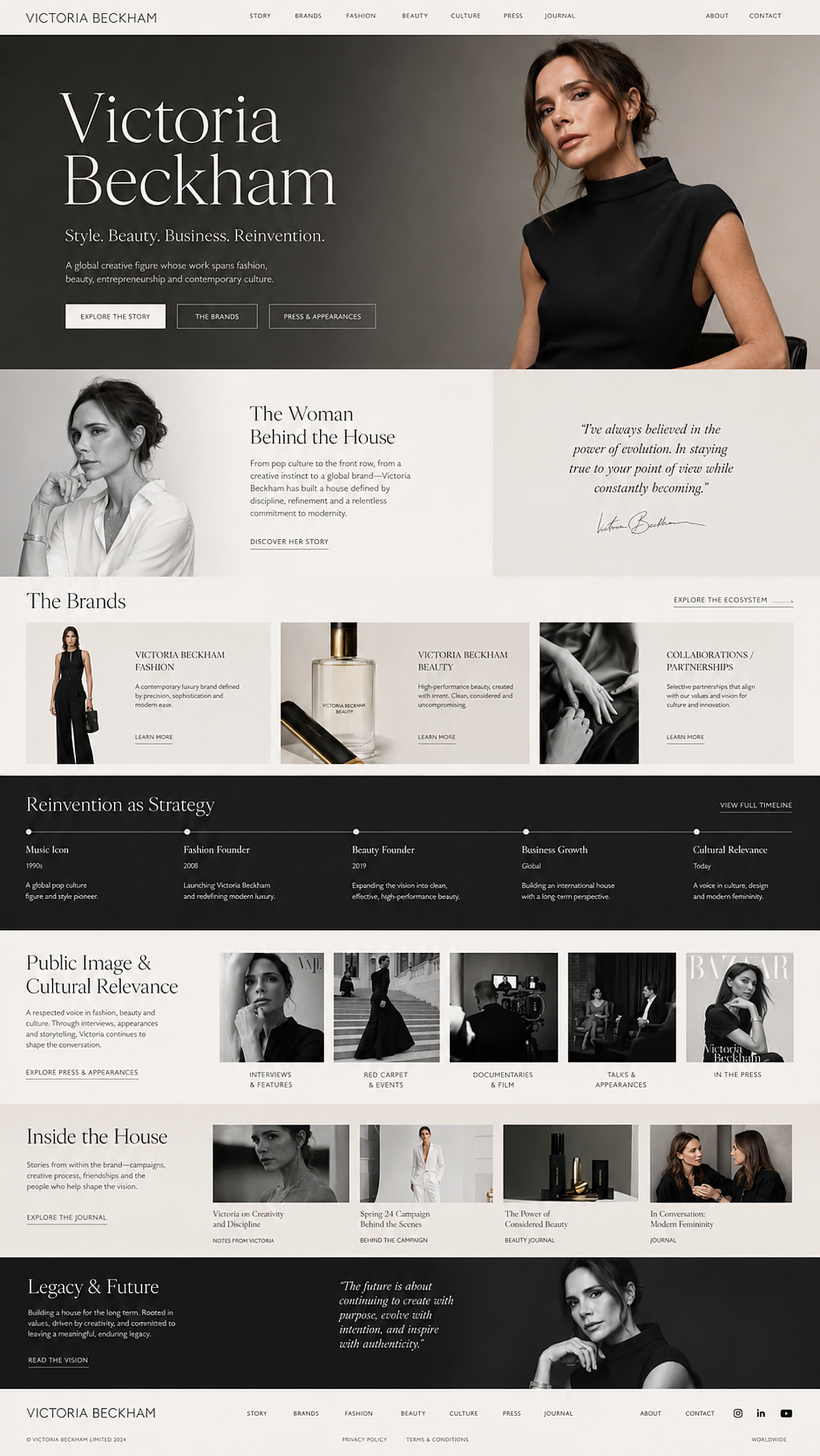
01 · Brand Hub
An editorial and institutional space designed to position Victoria Beckham as a public figure, founder, creative director and entrepreneur.
This proposal does not compete with ecommerce. It gives it context. Its role is to build authority, explain the brand universe and bring together her story, brands, cultural presence, collaborations, press visibility and future vision in one place.
The brand hub would work as a central platform for very different audiences: media, partners, investors, customers, followers, creative teams and people who want to understand the full dimension of Victoria Beckham beyond the product.
The brand hub does not sell product: it builds context, authority and trust.
Strategic objective
To create a brand platform capable of turning notoriety into structure, narrative and trust.
What this proposal organises
- •Personal history and professional evolution.
- •Brands and business lines.
- •Creative vision and institutional narrative.
- •Press, appearances and cultural relevance.
- •Collaborations and partnerships.
- •Editorial journal and creative notes.
- •Legacy, vision and next steps.
Design decisions
The visual direction needed to feel understated, editorial and timeless: a clean interface, generous white space, strong typographic hierarchy, highly present imagery and navigation designed to reveal the brand universe without losing clarity.
Conceptual outcome
A website capable of presenting Victoria Beckham not only as a celebrity or designer, but as a global creative figure with her own coherent ecosystem, ready to grow.
02 · Fashion ecommerce rebrand
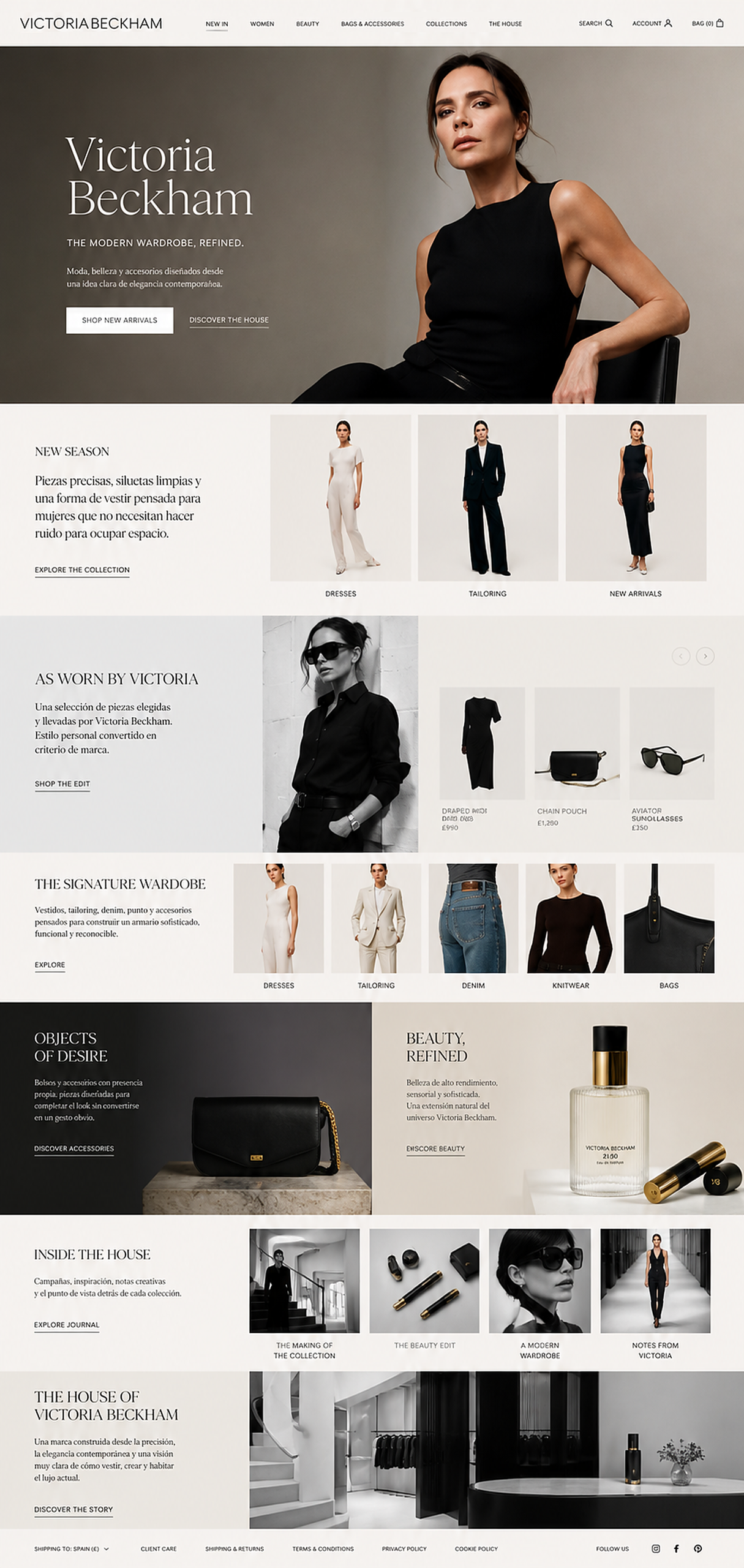
An evolution of the fashion and beauty website from an ecommerce perspective, but treated as a digital flagship store.
In this proposal, the focus is not Victoria Beckham as a public figure, but the product within an aspirational universe. The website should not simply display collections: it should build desire, provide context, support purchase and strengthen the brand’s luxury positioning.
The ecommerce experience would function as a living editorial front page: collections, key pieces, beauty, accessories, campaign content and purchase journeys organised with intention.
The ecommerce does not only convert: it educates the eye, elevates the product and reinforces positioning.
Strategic objective
To turn the online store into an editorial and commercial experience capable of elevating product, brand and conversion at the same time.
What this proposal organises
- •Collections and launches.
- •Key seasonal pieces.
- •Fashion, beauty, bags and accessories.
- •Editorial content and campaigns.
- •Recommendations and curated selection.
- •Clearer, more aspirational purchase journeys.
Design decision
The interface is conceived as a branded editorial front page: visual, clean, sophisticated and product-led. Less banner accumulation, more hierarchy, intention and flow.
Conceptual outcome
A more aspirational and strategic ecommerce experience, where purchasing is not perceived as an isolated action, but as the natural entry point into the Victoria Beckham universe.
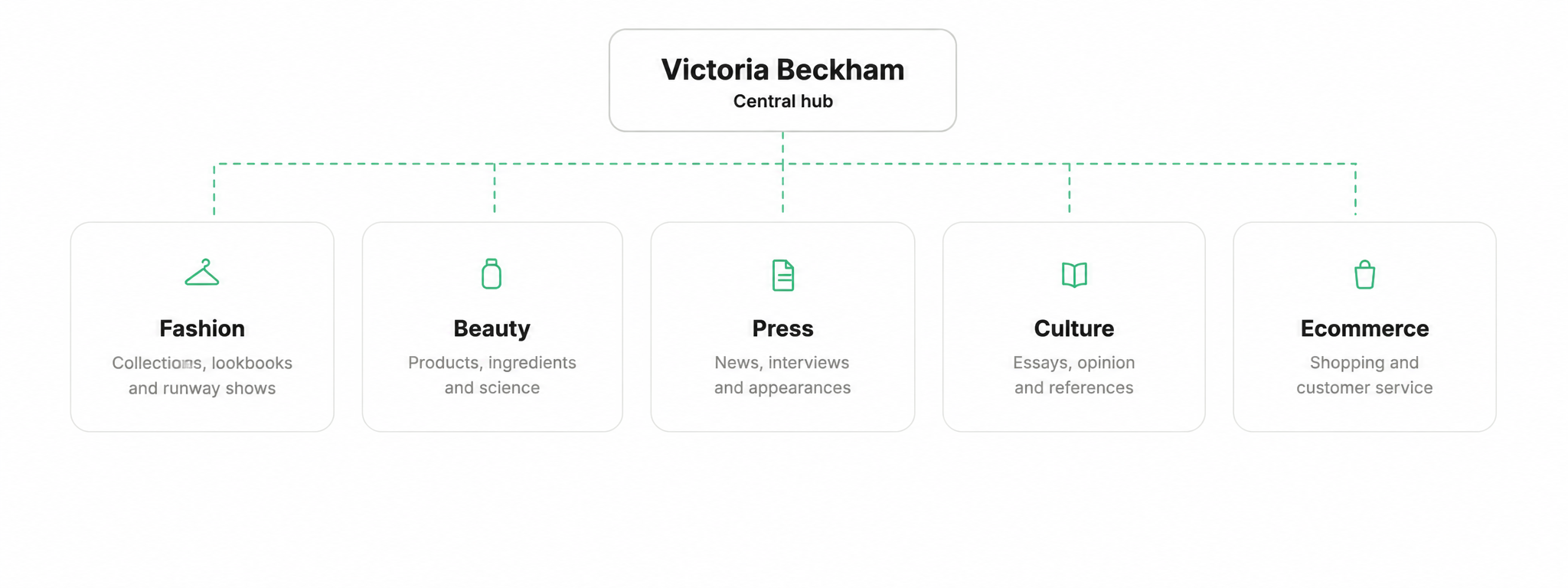
Ecosystem architecture
A central hub that organises content, audiences and brand layers, connected to specialised verticals.
What changes with this proposal?
- •
A highly visible brand, but with layers that could be read separatelyVictoria Beckham already has notoriety, international recognition and a consolidated visual identity. The challenge is not to make her more visible, but to better organise the dimensions that coexist within her ecosystem: public figure, fashion, beauty, ecommerce, press, culture, collaborations and business.
- •
The ecommerce experience could carry too much weight as the main point of contactWhen the online store becomes the main entry point into a complex brand, there is a risk that the digital experience is read almost exclusively through product. That can work for sales, but it does not always help explain the cultural, creative and business authority that supports the brand.
- •
The personal and professional story could be less structured as a strategic assetVictoria Beckham’s evolution —from pop icon to founder, creative director, entrepreneur and cultural figure— is one of the most valuable elements of her brand. Without a clear central space, that trajectory can end up distributed across interviews, press, campaigns, social media and external content.
- •
Fashion and beauty could coexist, but not always through a clear higher-level architectureFashion and beauty share aesthetic sensitivity, codes of sophistication and the same creative figure behind them. However, if each line is presented too independently, users may perceive them as separate verticals rather than as parts of the same universe.
- •
The cultural and editorial dimension could depend too much on external channelsPress, interviews, appearances, red carpets, campaigns and cultural moments are part of brand perception. If those contents live mainly outside the owned ecosystem, the brand loses part of its ability to organise its narrative from a central source.
- •
Each audience could need different journeys without the system clearly distinguishing themA customer looking to buy a dress does not need the same journey as a journalist, a beauty consumer, a potential partner or someone interested in the brand’s story. Without differentiated architecture, all those journeys can end up competing within the same space.
- •
A central brand hub capable of organising figure, story, brands and cultural authorityThe proposal introduces a brand hub that does not compete with ecommerce, but gives it context. Its role is to explain who Victoria Beckham is today, which brands form part of her ecosystem, what narrative supports her evolution and how her public figure connects with fashion, beauty, culture and business.
- •
An ecommerce experience more focused on desire, product and luxury experienceThe ecommerce evolution allows the online store to do its job better: presenting collections, elevating product, integrating beauty and accessories, supporting purchase and building a more aspirational, editorial and conversion-oriented experience.
- •
A separation of functions without fragmenting identityThe brand hub builds authority. The ecommerce turns desire into purchase. Both pieces fulfil different roles, but they are connected through the same visual, narrative and strategic direction.
- •
Fashion, beauty, culture, press and collaborations are understood as parts of a systemThe architecture allows each vertical to have its own space without feeling disconnected. Fashion, beauty, editorial content, cultural presence and professional opportunities are organised as complementary layers of the same brand.
- •
The personal brand becomes a strategic platformVictoria Beckham is no longer read only as a name attached to product, but as a creative and business figure with her own universe. The brand hub turns notoriety into context, authority and trust.
- •
Each audience finds a clearer journey according to its intentionThe proposal makes it possible to differentiate routes: buy, discover beauty, consult press, understand the story, explore collaborations or enter the editorial universe. The result is a clearer, more flexible experience, better prepared to grow.
Strategic decision
Pibeca's role
Does your brand need to build authority without losing desirability?
We design digital presences that clarify your positioning, elevate brand perception and turn your visual universe into a coherent, compelling experience.